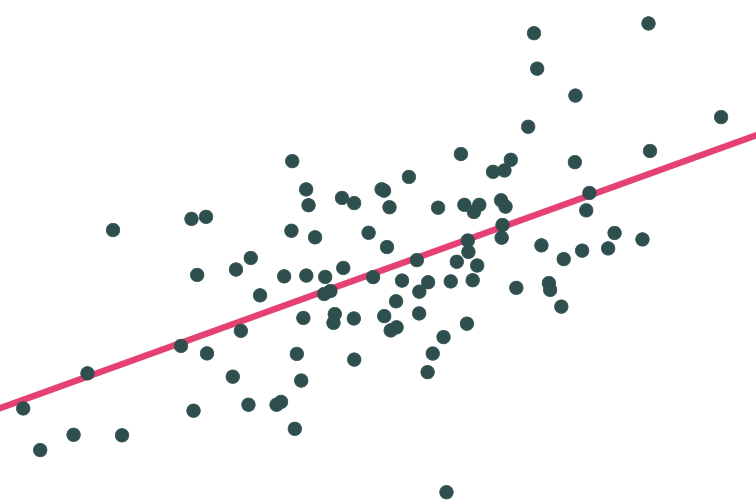
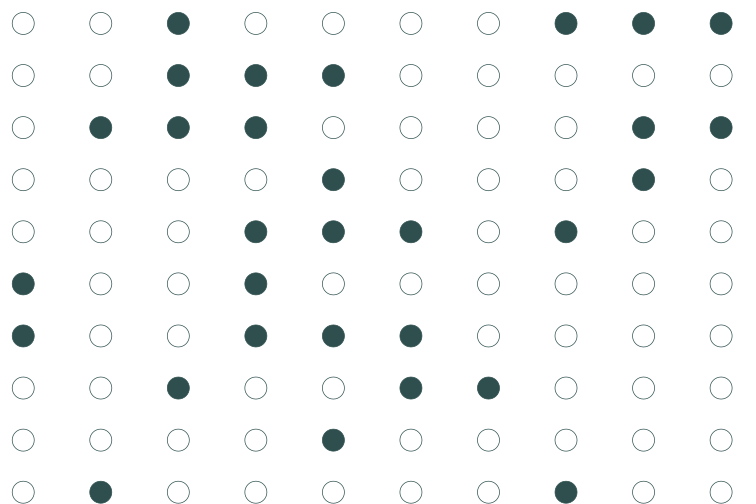
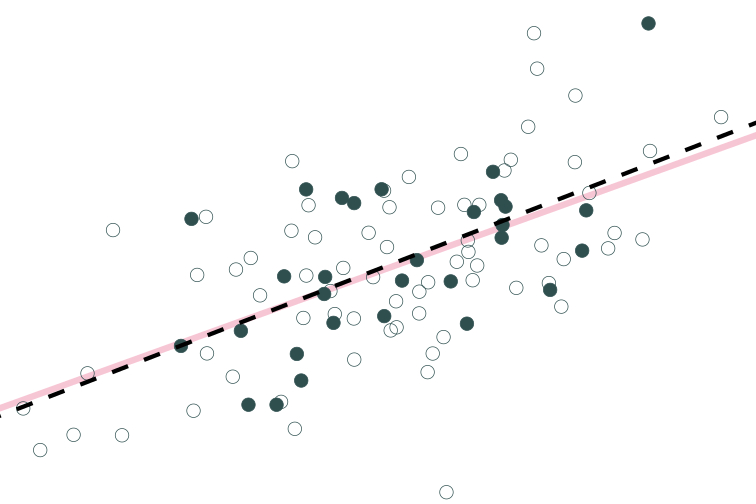
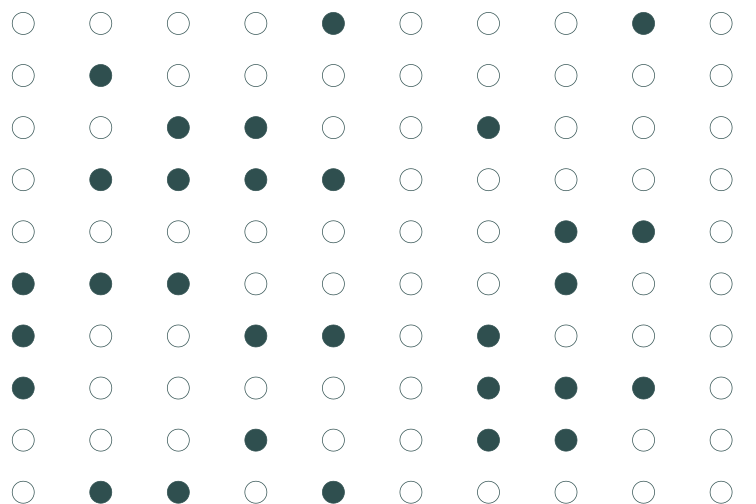
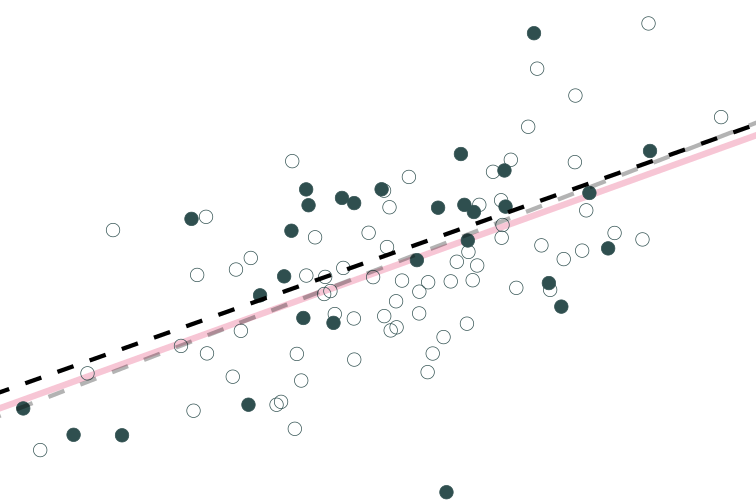
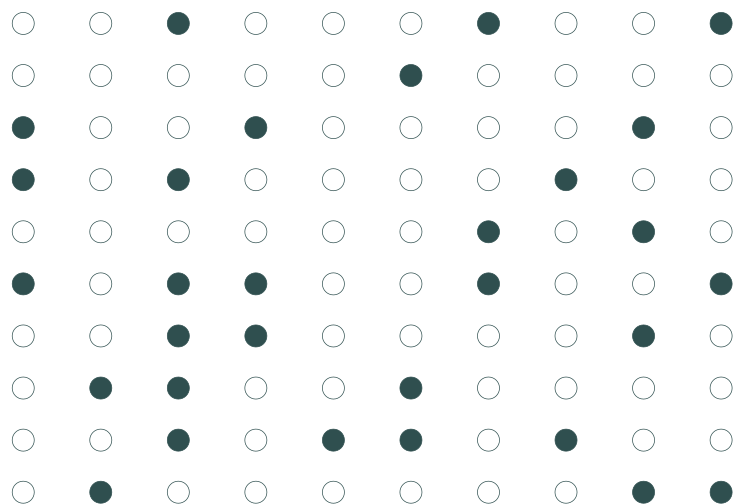
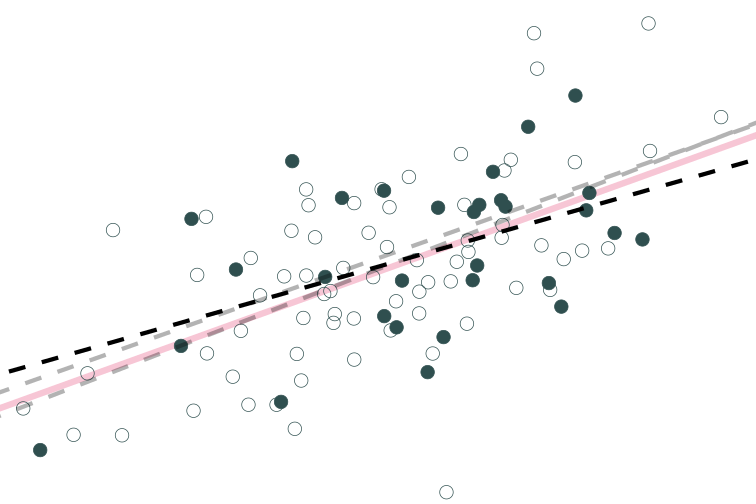
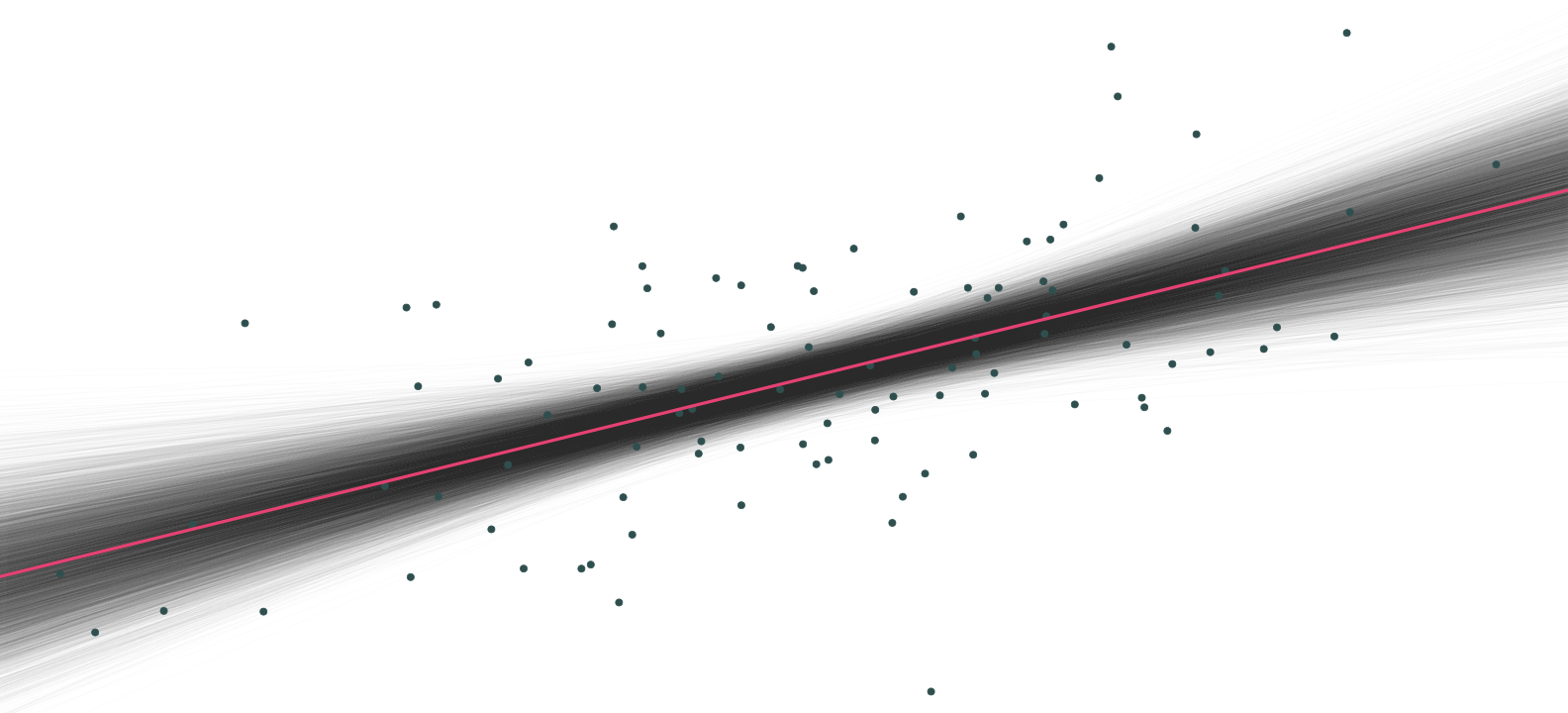
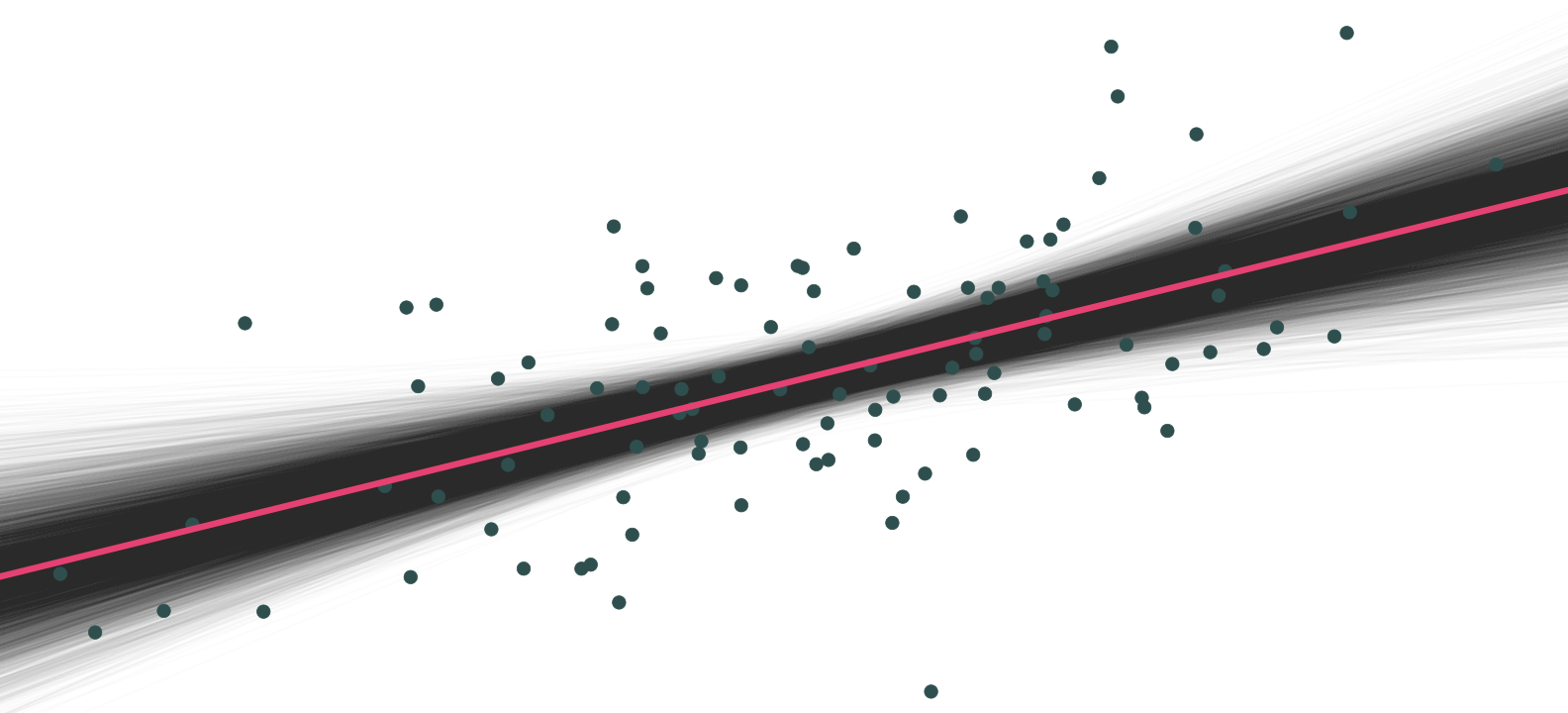
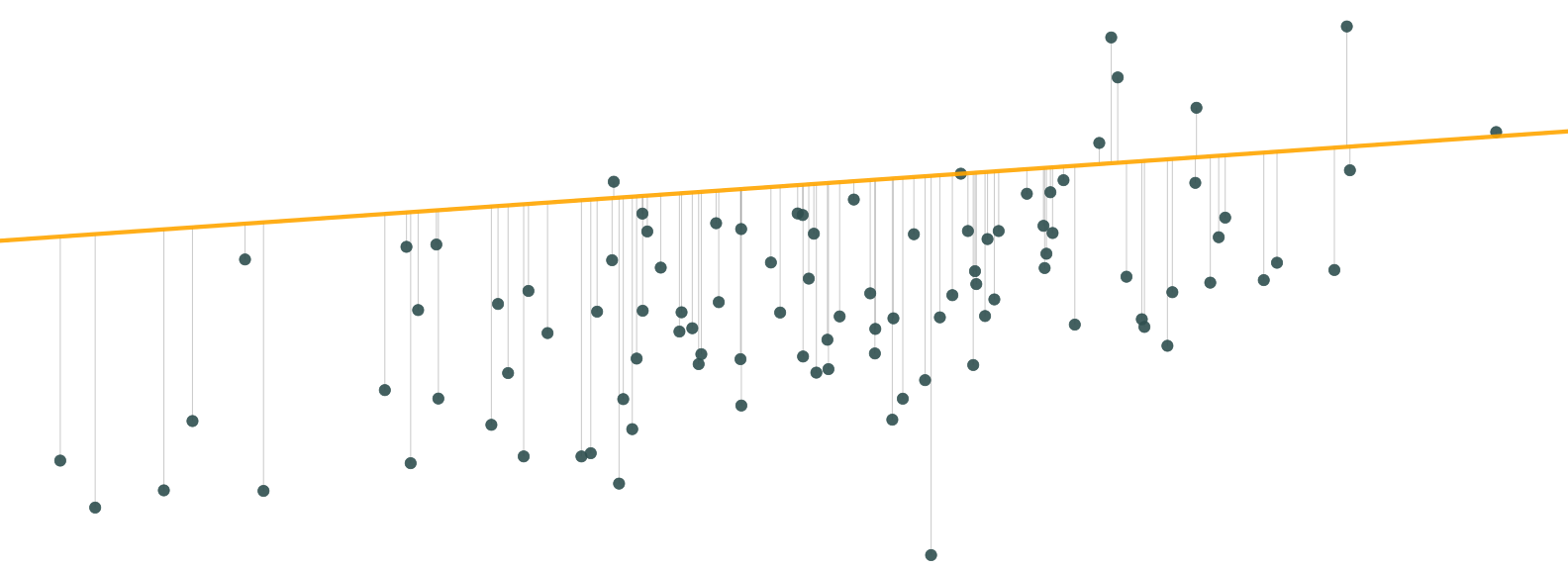
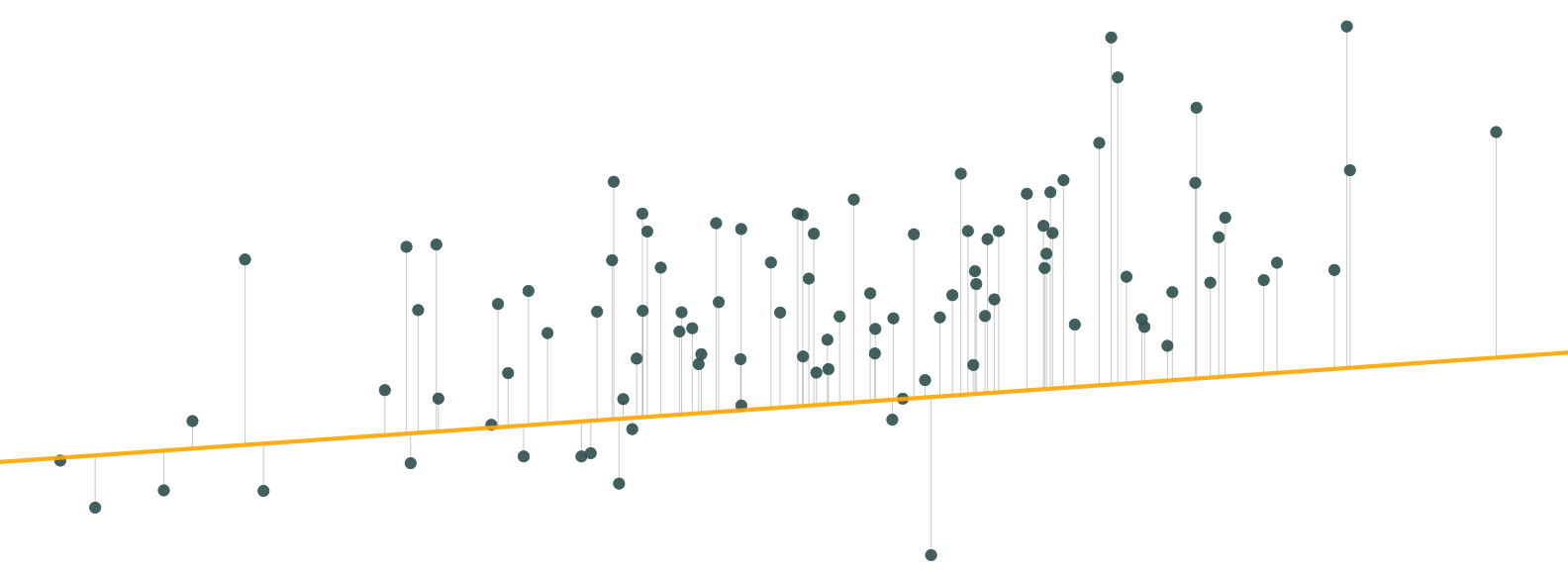
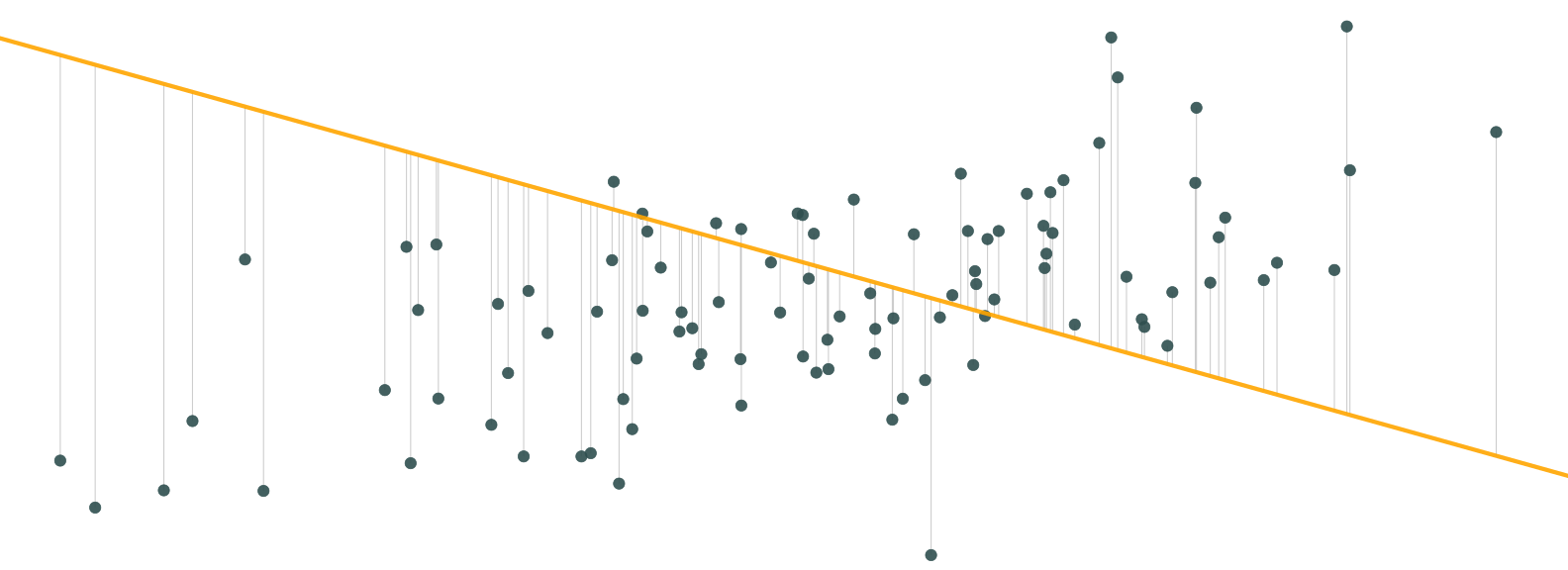
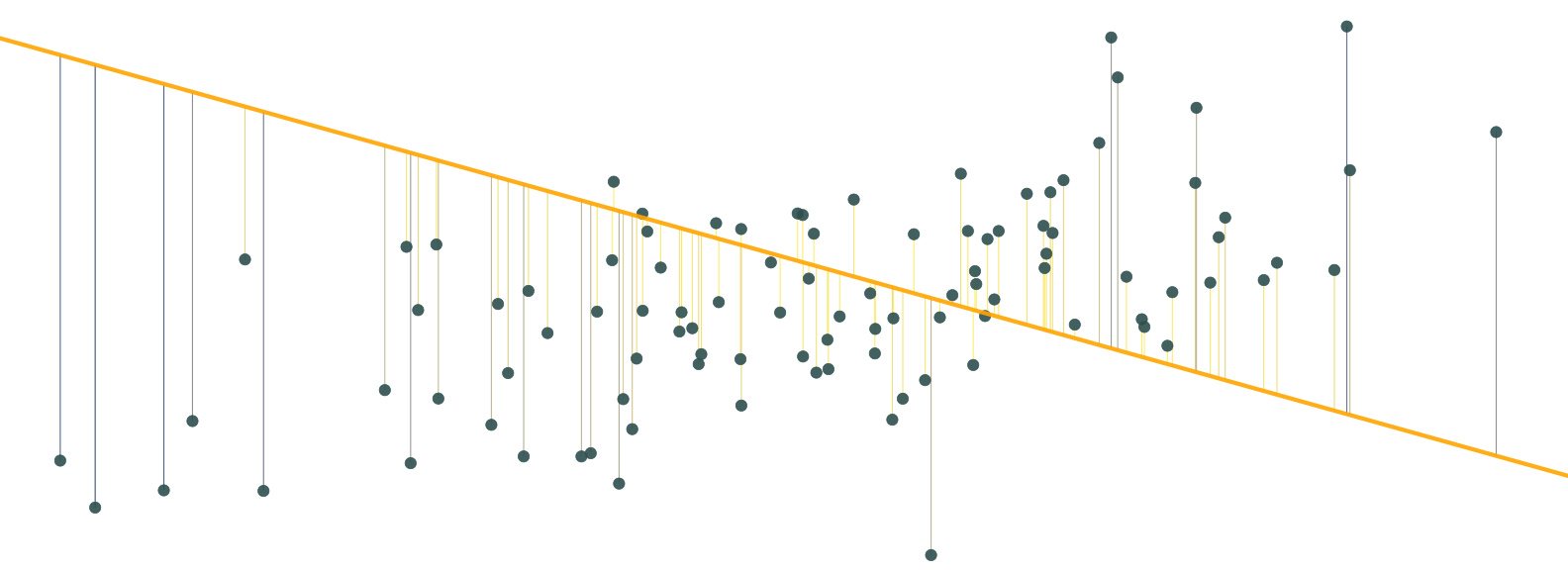
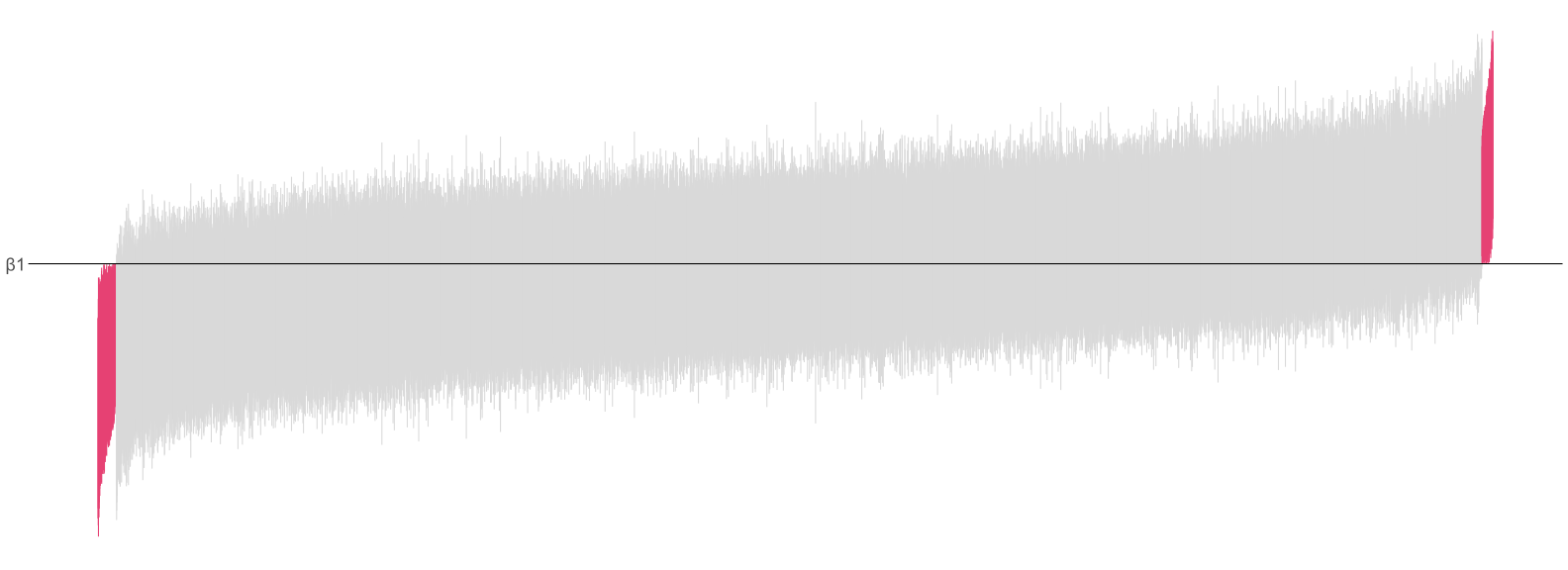
(This exercise is called a (Monte Carlo) simulation.)
Population vs. sample
Population vs. sample
Question: Why do we care about population vs. sample?
On average, our regression lines match the population line very nicely.
However, individual lines (samples) can really miss the mark.
Differences between individual samples and the population lead to uncertainty.
Population vs. sample
Question: Why do we care about population vs. sample?
Answer: Uncertainty matters.
\(\hat{\beta}\) itself is a random variable—dependent upon the random sample. When we take a sample and run a regression, we don’t know if it’s a ‘good’ sample ( \(\hat{\beta}\) is close to \(\beta\)) or a ‘bad sample’ (our sample differs greatly from the population).
Uncertainty
Estimating standard errors for our estimates.
Testing hypotheses.
Correcting for heteroskedasticity and autocorrelation1
First, let’s refresh on how we get these (uncertain) regression estimates.
Linear regression
The estimator
We can estimate a regression line in R (lm(y ~ x, my_data)). But where do these estimates come from?
A few slides back:
\[ \hat{y}_i = \hat{\beta}_0 + \hat{\beta}_1 x_i \] which gives us the best-fit line through our dataset.
But what do we mean by “best-fit line”?
Being the “best”
Question: What do we mean by best-fit line?
Answers:
In general, best-fit line means the line that minimizes the sum of squared errors (SSE):
\[
\text{ESS} = \sum_{i = 1}^{n} e_i^2\quad
\]
where \(\quad e_i = y_i - \hat{y}_i\)
Ordinary least squares (OLS) minimizes the sum of the squared errors.
Based upon a set of (mostly palatable) assumptions, OLS
Is unbiased
Is the best (minimum variance) linear unbiased estimator
OLS vs. other lines/estimators
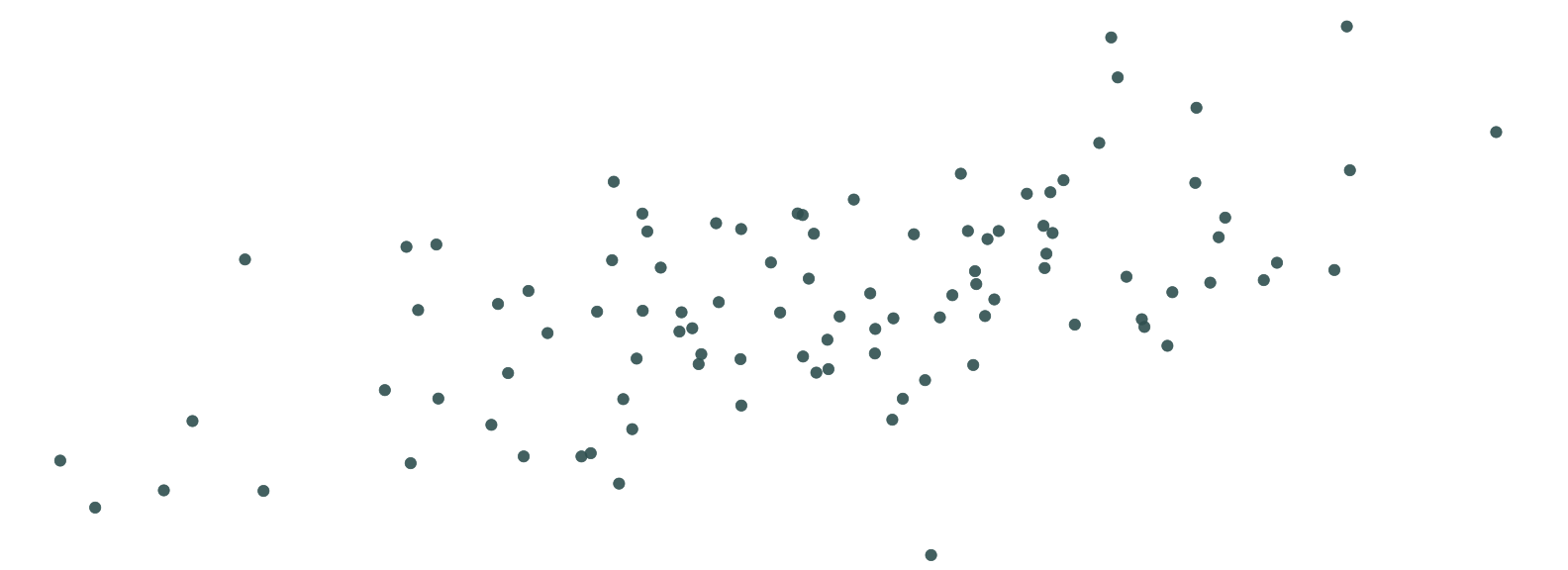
Let’s consider the dataset we previously generated.
OLS vs. other lines/estimators
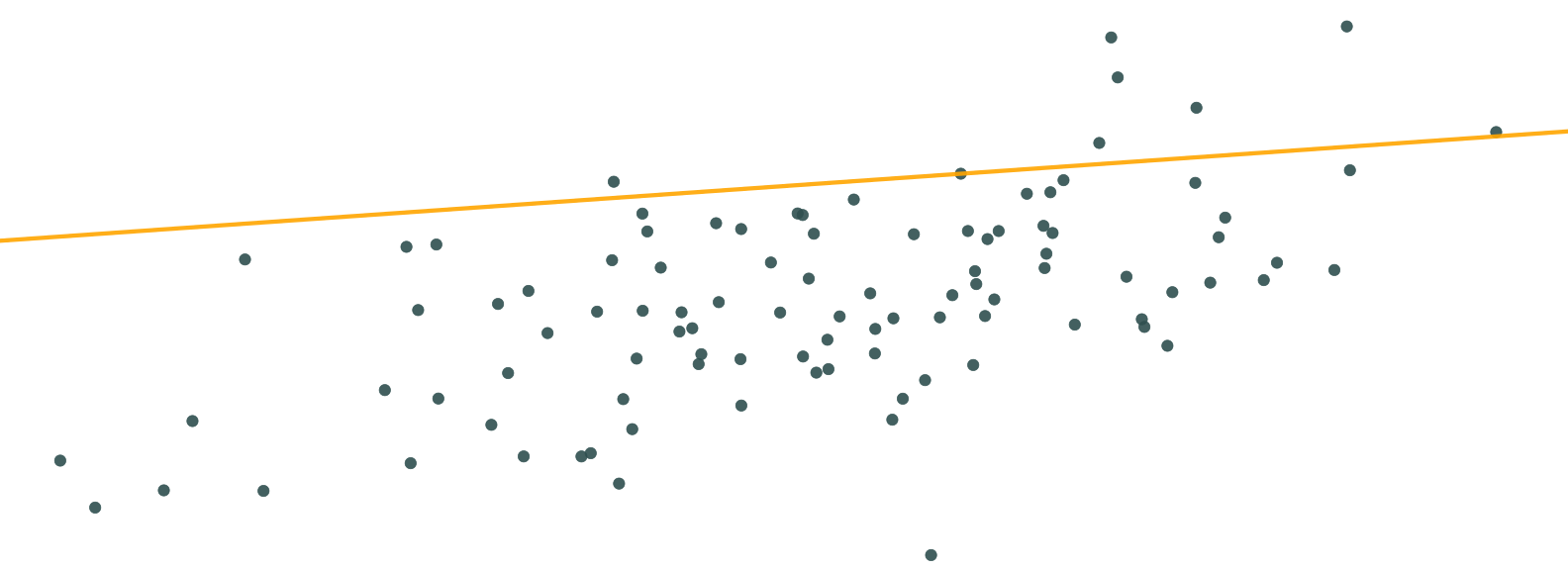
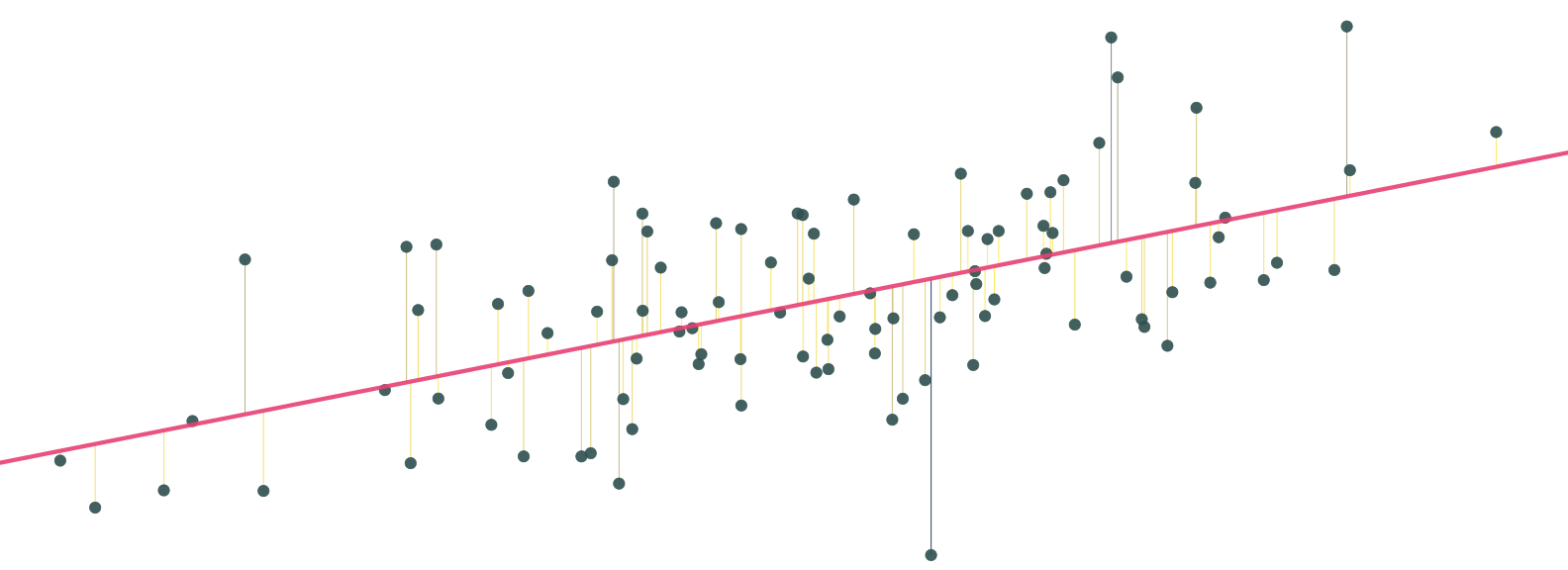
For any line \(\left(\hat{y} = \hat{\beta}_0 + \hat{\beta}_1 x\right)\)
OLS vs. other lines/estimators
For any line \((\hat{y} = \hat{\beta}_0 + \hat{\beta}_1 x)\), we can calculate errors: \(e_i = y_i - \hat{y}_i\)
OLS vs. other lines/estimators
For any line \(\left(\hat{y} = \hat{\beta}_0 + \hat{\beta}_1 x\right)\), we can calculate errors: \(e_i = y_i - \hat{y}_i\)
OLS vs. other lines/estimators
For any line \(\left(\hat{y} = \hat{\beta}_0 + \hat{\beta}_1 x\right)\), we can calculate errors: \(e_i = y_i - \hat{y}_i\)
OLS vs. other lines/estimators
SSE squares the errors \(\left(\sum e_i^2\right)\): bigger errors get bigger penalties.
OLS vs. other lines/estimators
The OLS estimate is the combination of \(\hat{\beta}_0\) and \(\hat{\beta}_1\) that minimize SSE.
OLS: formally
In simple linear regression, the OLS estimator comes from choosing the \(\hat{\beta}_0\) and \(\hat{\beta}_1\) that minimize the sum of squared errors (SSE), i.e.,
Recall: Minimizing a multivariate function requires (1) first derivatives equal zero (the 1st-order conditions) and (2) second-order conditions (concavity).
OLS: formally
We’re getting close. We need to minimize SSE. We’ve showed how SSE relates to our sample (our data: \(x\) and \(y\)) and our estimates (i.e., \(\hat{\beta}_0\) and \(\hat{\beta}_1\)).
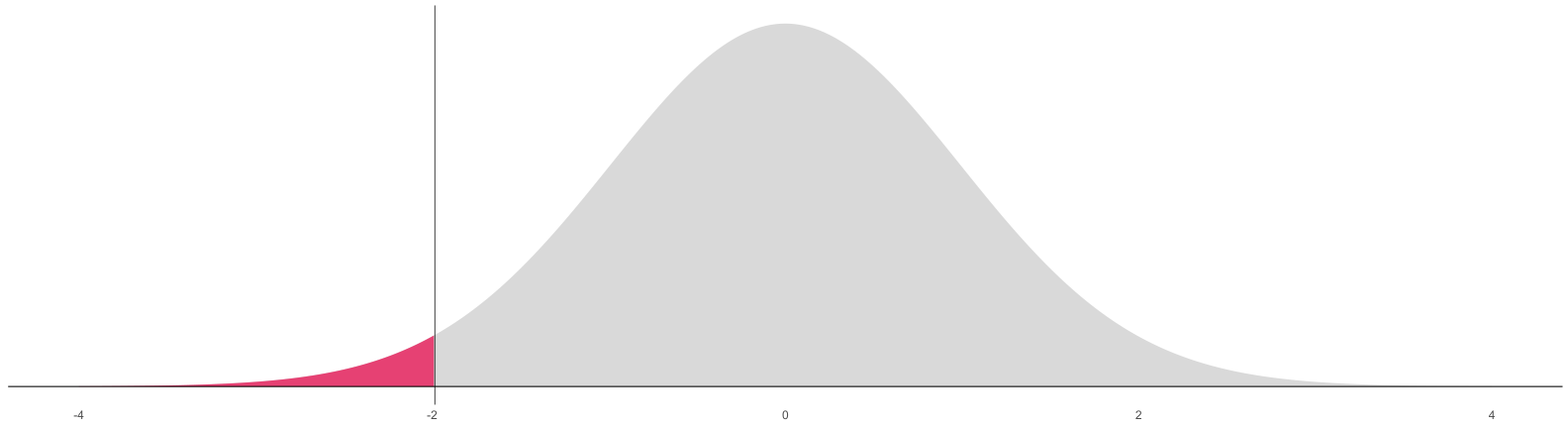
Recall that we use probability density functions (PDFs) to describe the probability a continuous random variable takes on a range of values. (The total area = 1.)
These PDFs characterize probability distributions, and the most common/famous/popular distributions get names (e.g., normal, t, Gamma).
OLS: Properties
Refresher: Density functions
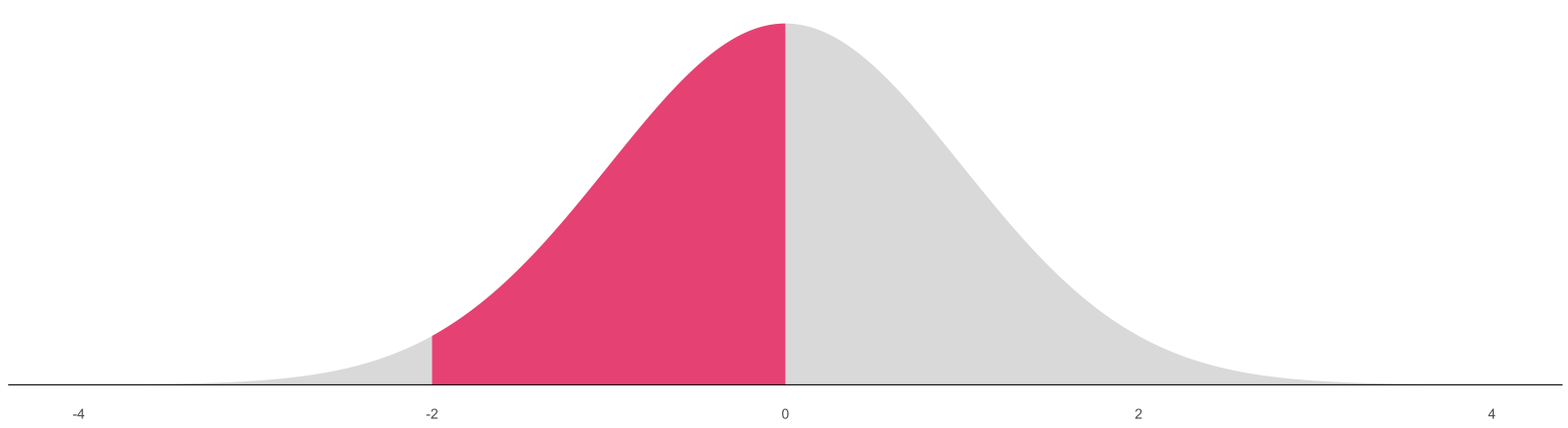
The probability a standard normal random variable takes on a value between -2 and 0: \(\mathop{\text{P}}\left(-2 \leq X \leq 0\right) = 0.48\)
OLS: Properties
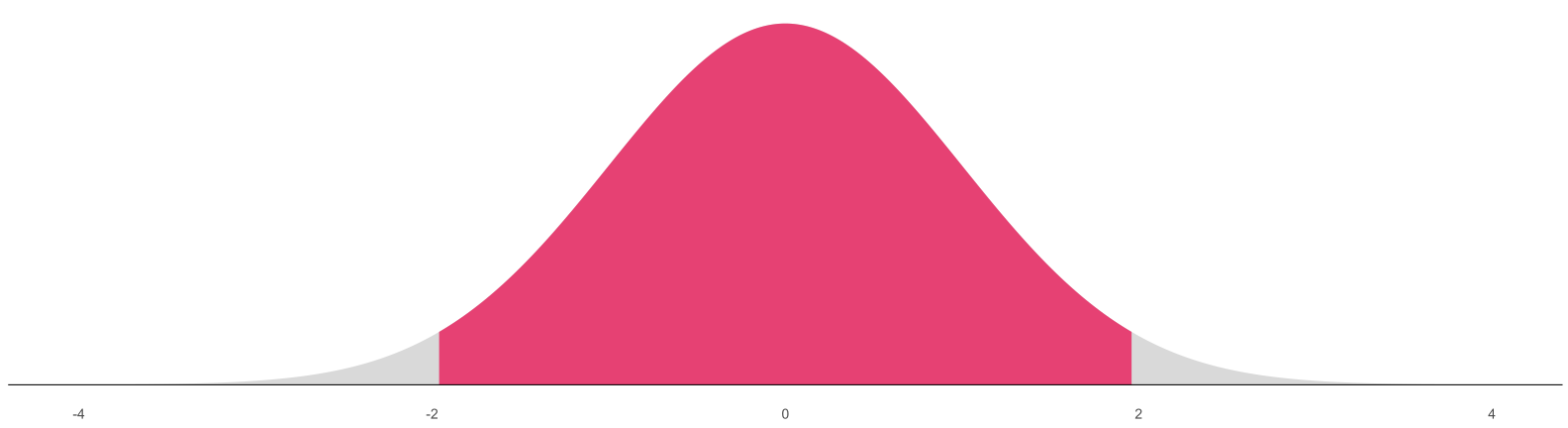
The probability a standard normal random variable takes on a value between -1.96 and 1.96: \(\mathop{\text{P}}\left(-1.96 \leq X \leq 1.96\right) = 0.95\)
OLS: Properties
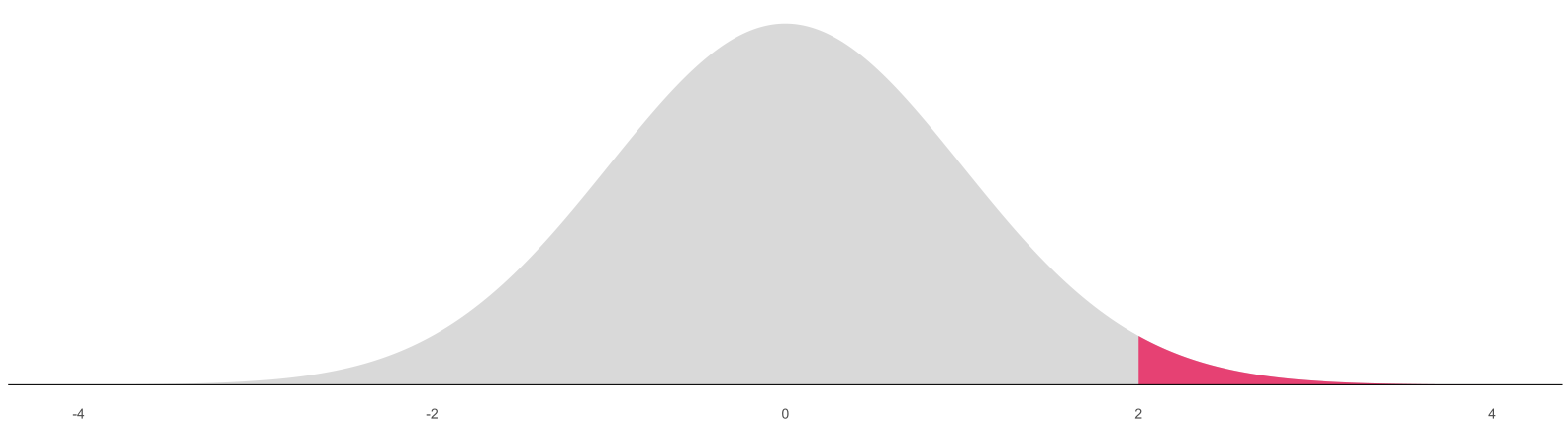
The probability a standard normal random variable takes on a value beyond 2: \(\mathop{\text{P}}\left(X > 2\right) = 0.023\)
OLS: Properties
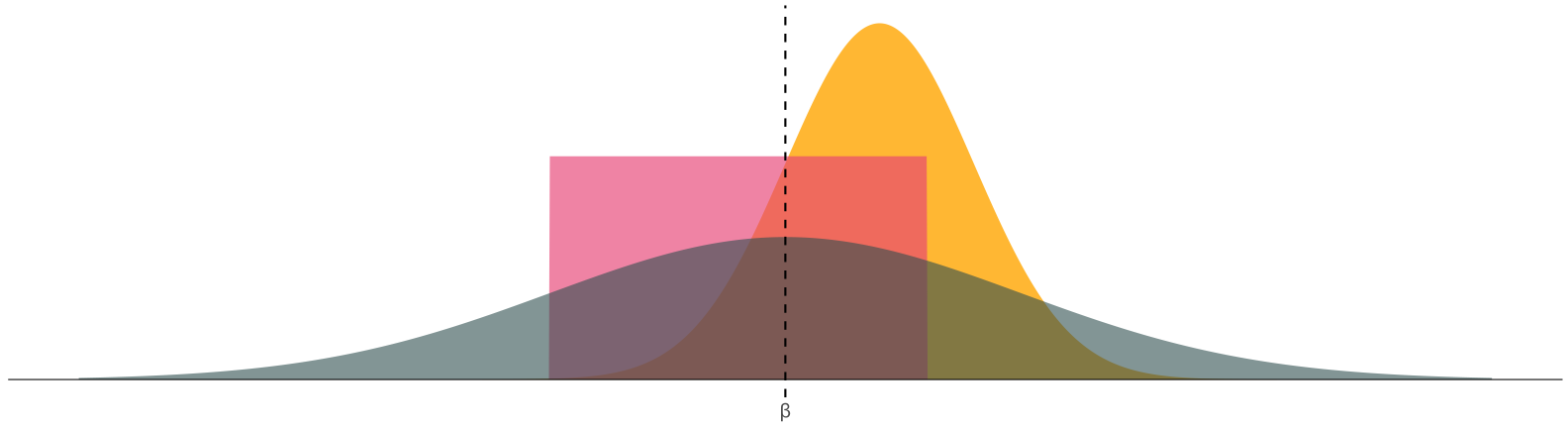
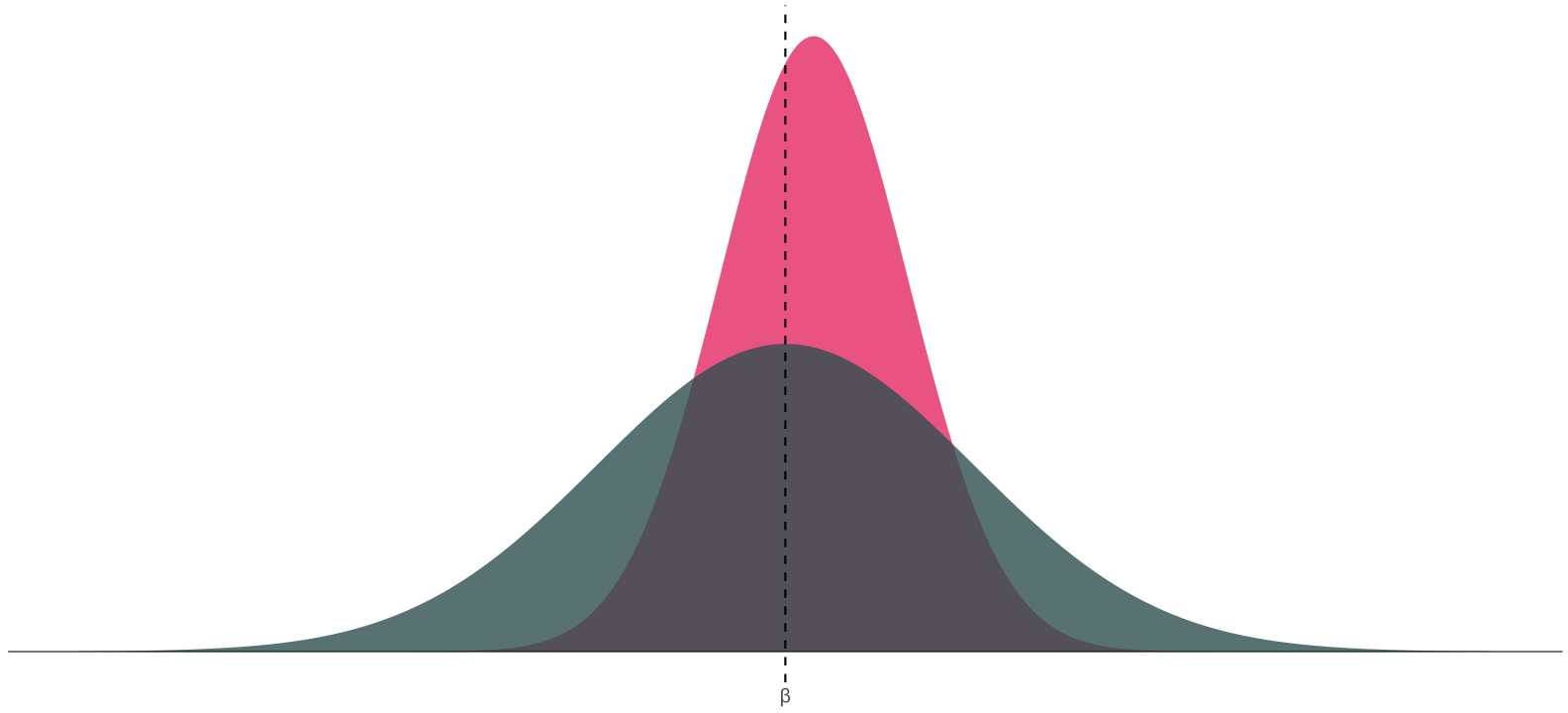
Imagine we are trying to estimate an unknown parameter \(\beta\), and we know the distributions of three competing estimators. Which one would we want? How would we decide?
OLS: Properties
Question: What properties might we care about for an estimator?
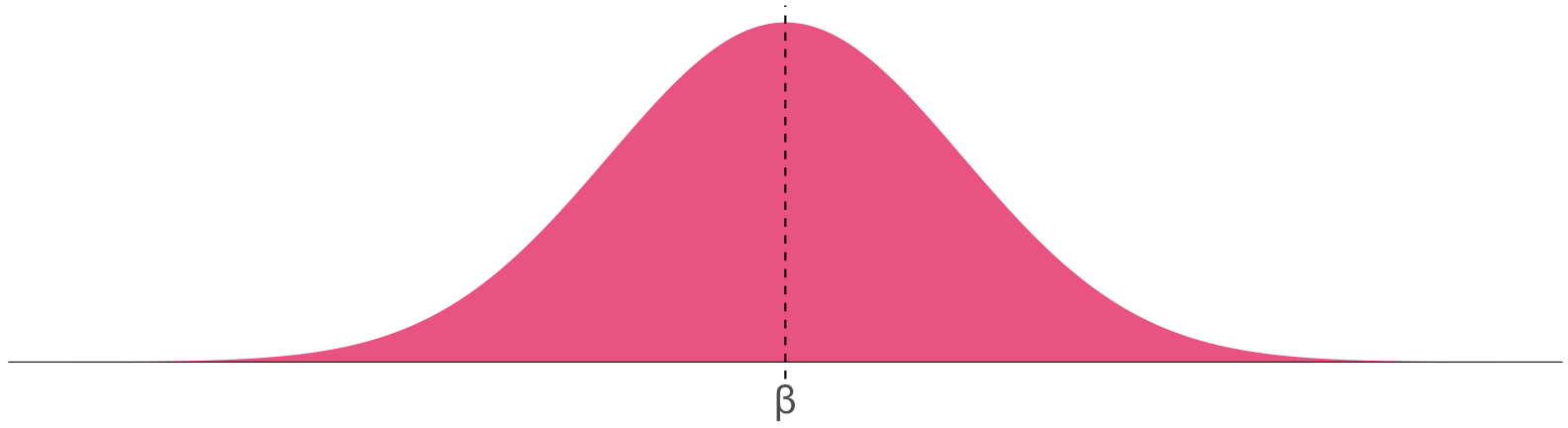
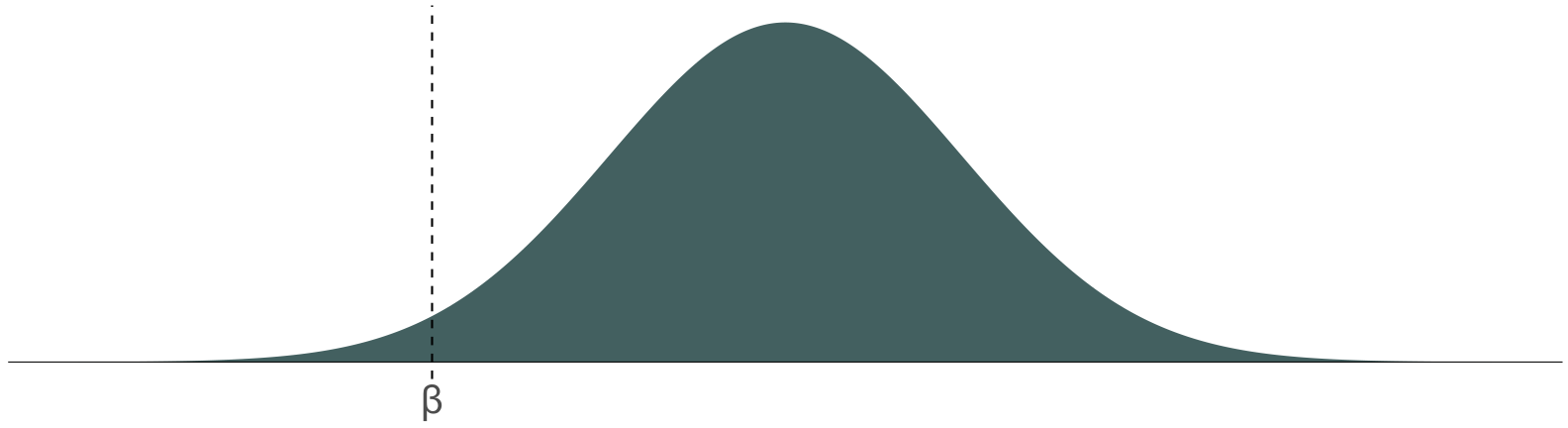
Answer one: Bias.
On average (after many samples), does the estimator tend toward the correct value?
More formally: Does the mean of estimator’s distribution equal the parameter it estimates?
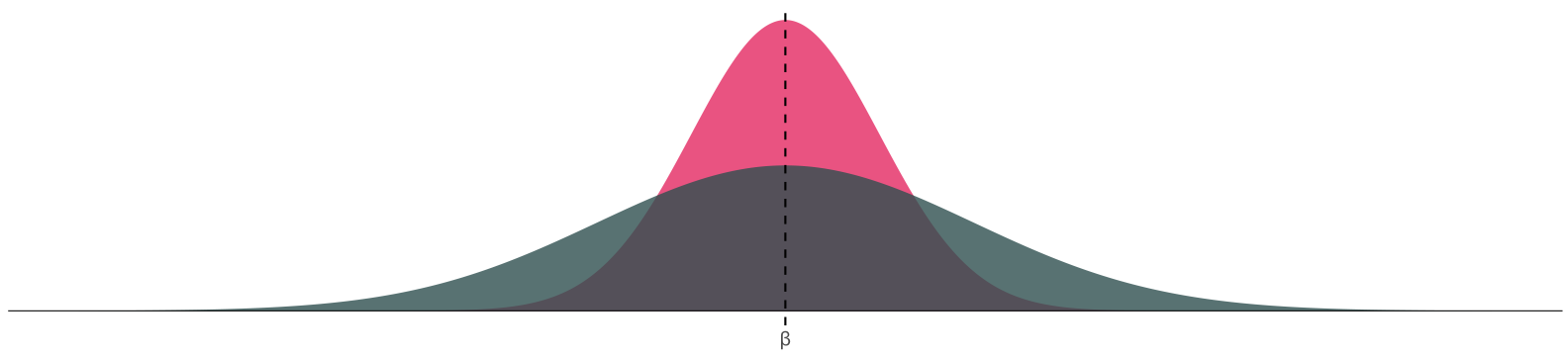
Lower variance estimators mean we get estimates closer to the mean in each sample.
OLS: Properties
Answer two: Variance.
OLS: Properties
Answer one: Bias.
Answer two: Variance.
Subtlety: The bias-variance tradeoff.
Should we be willing to take a bit of bias to reduce the variance?
In statistics, we generally stick with unbiased (or consistent) estimators. But other disciplines (especially computer science) think a bit more about this tradeoff.
The bias-variance tradeoff.
OLS: Properties
As you might have guessed by now,
OLS is unbiased.
OLS has the minimum variance of all unbiased linear estimators.
OLS: Properties
But… these (very nice) properties depend upon a set of assumptions:
The population relationship is linear in parameters with an additive disturbance.
Our \(X\) variable is exogenous, i.e., \(\mathop{\boldsymbol{E}}\left[ u \mid X \right] = 0\).
The \(X\) variable has variation. And if there are multiple explanatory variables, they are not perfectly collinear.
The population disturbances \(u_i\) are independently and identically distributed as normal random variables with mean zero\(\left( \mathop{\boldsymbol{E}}\left[ u \right] = 0 \right)\) and variance \(\sigma^2\) (i.e., \(\mathop{\boldsymbol{E}}\left[ u^2 \right] = \sigma^2\)). Independently distributed and mean zero jointly imply \(\mathop{\boldsymbol{E}}\left[ u_i u_j \right] = 0\) for any \(i\neq j\).
OLS: Assumptions
Different assumptions guarantee different properties:
Assumptions (1), (2), and (3) make OLS unbiased.
Assumption (4) gives us an unbiased estimator for the variance of our OLS estimator.
There are many ways how real life may violate these assumptions. For instance:
Non-linear relationships in our parameters/disturbances (or misspecification).
Disturbances that are not identically distributed and/or not independent.
Violations of exogeneity (especially omitted-variable bias).
OLS: Conditional expectation
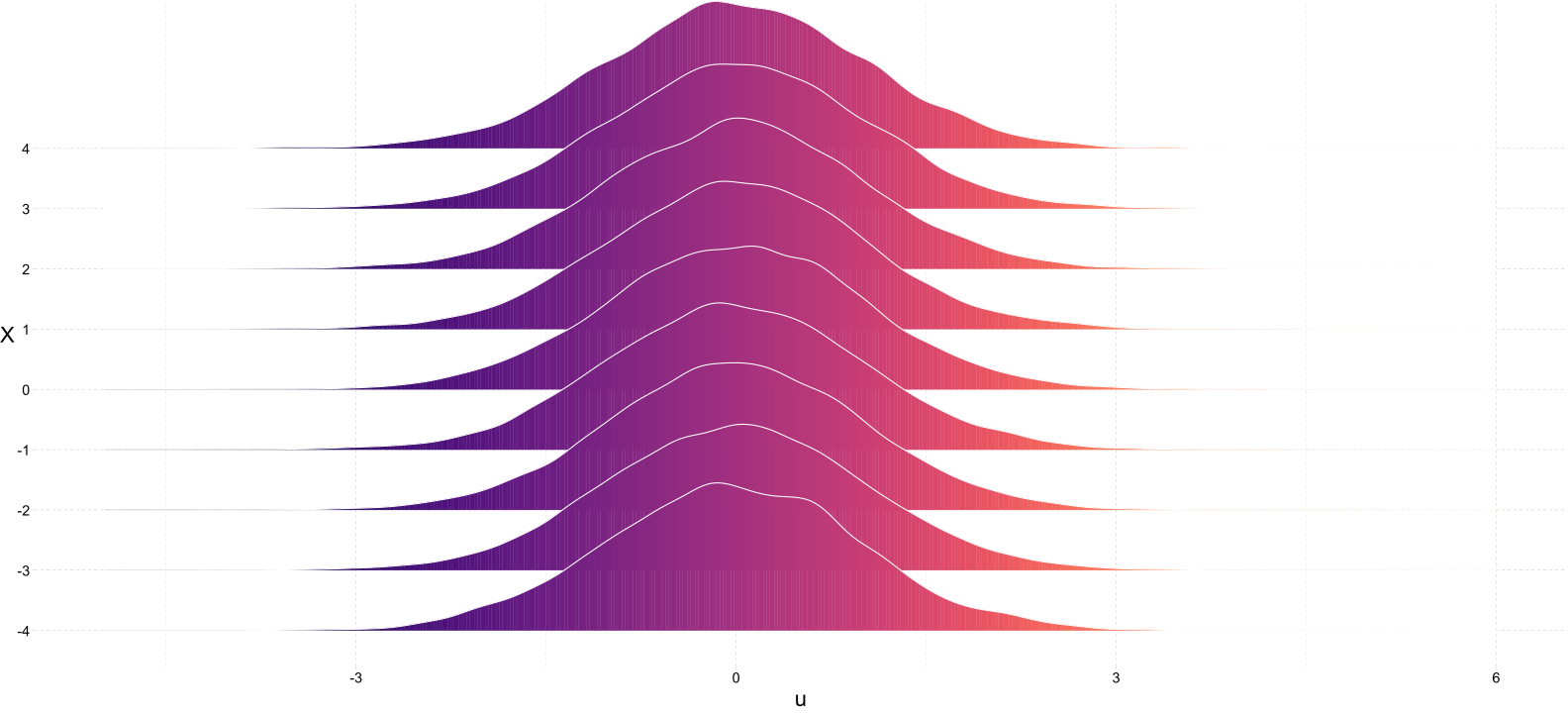
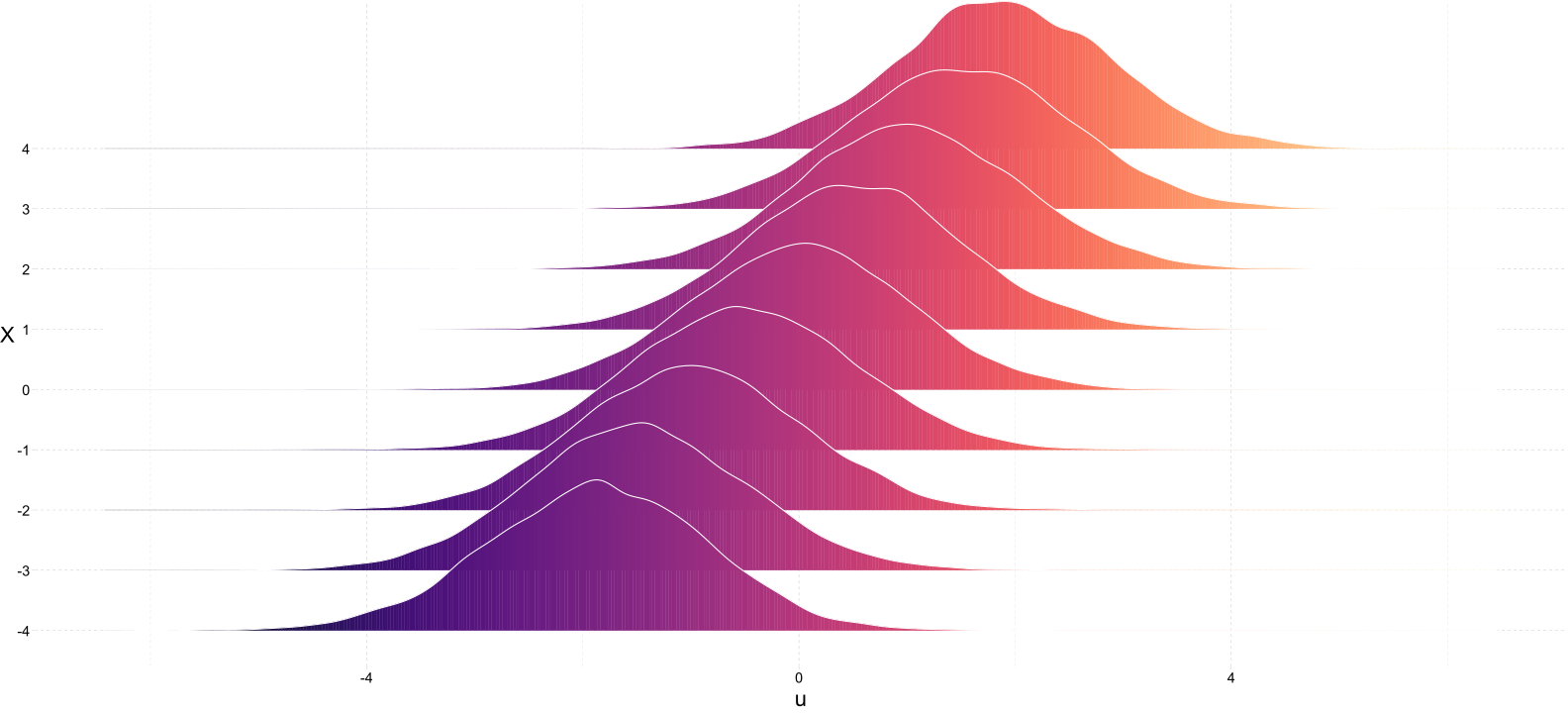
For many applications, our most important assumption is exogeneity, i.e., \[
\begin{align}
\mathop{E}\left[ u \mid X \right] = 0
\end{align}
\]
but what does it actually mean?
One way to think about this definition:
For any value of \(X\), the mean of the residuals must be zero.
E.g., \(\mathop{E}\left[ u \mid X=1 \right]=0\)and\(\mathop{E}\left[ u \mid X=100 \right]=0\)
E.g., \(\mathop{E}\left[ u \mid X_2=\text{Female} \right]=0\)and\(\mathop{E}\left[ u \mid X_2=\text{Male} \right]=0\)
Graphically…
Valid exogeneity, i.e., \(\mathop{E}\left[ u \mid X \right] = 0\)
Invalid exogeneity, i.e., \(\mathop{E}\left[ u \mid X \right] \neq 0\)
Uncertainty and inference
Is there more?
Up to this point, we know OLS has some nice properties, and we know how to estimate an intercept and slope coefficient via OLS.
Our current workflow:
Get data (points with \(x\) and \(y\) values)
Regress \(y\) on \(x\)
Plot the OLS line (i.e., \(\hat{y} = \hat{\beta}_0 + \hat{\beta}_1\))
Done?
But how do we actually learn something from this exercise?
There is more
But how do we actually learn something from this exercise?
Based upon our value of \(\hat{\beta}_1\), can we rule out previously hypothesized values?
How confident should we be in the precision of our estimates?
How well does our model explain the variation we observe in \(y\)?
We need to be able to deal with uncertainty. Enter: Inference.
Learning from our errors
As our previous simulation pointed out, our problem with uncertainty is that we don’t know whether our sample estimate is close or far from the unknown population parameter.
However, all is not lost. We can use the errors \(\left(e_i = y_i - \hat{y}_i\right)\) to get a sense of how well our model explains the observed variation in \(y\).
When our model appears to be doing a “nice” job, we might be a little more confident in using it to learn about the relationship between \(y\) and \(x\).
Now we just need to formalize what a “nice job” actually means.
Learning from our errors
First off, we will estimate the variance of \(u_i\) (recall: \(\mathop{\text{Var}} \left( u_i \right) = \sigma^2\)) using our squared errors, i.e.,
\[ s^2 = \dfrac{\sum_i e_i^2}{n - k} \]
where \(k\) gives the number of slope terms and intercepts that we estimate (e.g., \(\beta_0\) and \(\beta_1\) would give \(k=2\)).
\(s^2\) is an unbiased estimator of \(\sigma^2\).
Learning from our errors
You then showed that the variance of \(\hat{\beta}_1\) (for simple linear regression) is
Recall: The standard error of an estimator is the standard deviation of the estimator’s distribution.
Learning from our errors
Standard error output is standard in R’s lm():
tidy(lm(y ~ x, pop_df))
# A tibble: 2 × 5
  term        estimate std.error statistic  p.value
  <chr>          <dbl>     <dbl>     <dbl>    <dbl>
1 (Intercept)    2.53     0.422       6.00 3.38e- 8
2 x              0.567    0.0793      7.15 1.59e-10
Learning from our errors
We use the standard error of \(\hat{\beta}_1\), along with \(\hat{\beta}_1\) itself, to learn about the parameter \(\beta_1\).
After deriving the distribution of \(\hat{\beta}_1\), we have two (related) options for formal statistical inference (learning) about our unknown parameter \(\beta_1\):
Confidence intervals: Use the estimate and its standard error to create an interval that, when repeated, will generally contain the true parameter.
Hypothesis tests: Determine whether there is statistically significant evidence to reject a hypothesized value or range of values.
Confidence intervals
We construct \((1-\alpha)\)-level confidence intervals for \(\beta_1\)
For example, 100 obs., two coefficients (i.e., \(\hat{\beta}_0\) and \(\hat{\beta}_1 \implies k = 2\)), and \(\alpha = 0.05\) (for a 95% confidence interval) gives us \(t_{0.025,\,98} = -1.98\)
Confidence intervals
We construct \((1-\alpha)\)-level confidence intervals for \(\beta_1\)
So we have a confidence interval for \(\beta_1\), i.e., \(\left[ 0.410,\, 0.724 \right]\).
What does it mean?
Informally: The confidence interval gives us a region (interval) in which we can place some trust (confidence) for containing the parameter.
More formally: If repeatedly sample from our population and construct confidence intervals for each of these samples, \((1-\alpha)\) percent of our intervals (e.g., 95%) will contain the population parameter somewhere in the interval.
Now back to our simulation…
Confidence intervals
We drew 10,000 samples (each of size \(n = 30\)) from our population and estimated our regression model for each of these simulations:
Now, let’s estimate 95% confidence intervals for each of these intervals…
Confidence intervals
From our previous simulation: 97.9% of 95% confidences intervals contain the true parameter value of \(\beta_1\).
Hypothesis testing
Hypothesis testing
In many applications, we want to know more than a point estimate or a range of values. We want to know what our statistical evidence says about existing theories.
We want to test hypotheses posed by officials, politicians, economists, scientists, friends, weird neighbors, etc.
Examples
Does increasing police presence reduce crime?
Does building a giant wall reduce crime?
Does shutting down a government adversely affect the economy?
Does legal cannabis reduce drunk driving or reduce opiod use?
Do air quality standards increase health and/or reduce jobs?
Hypothesis testing
Hypothesis testing relies upon very similar results and intuition.
While uncertainty certainly exists, we can still build reliable statistical tests (rejecting or failing to reject a posited hypothesis).
OLS t test Our (null) hypothesis states that \(\beta_1\) equals a value \(c\), i.e., \(H_o:\: \beta_1 = c\)
From OLS’s properties, we can show that the test statistic
meaning that our test statistic is more extreme than the critical value.
Alternatively, we can calculate the p-value that accompanies our test statistic, which effectively gives us the probability of seeing our test statistic or a more extreme test statistic if the null hypothesis were true.
Very small p-values (generally < 0.05) mean that it would be unlikely to see our results if the null hyopthesis were really true—we tend to reject the null for p-values below 0.05.
Hypothesis testing
R default to testing hypotheses against the value zero.
lm(y ~ x, data = pop_df) %>%tidy()
# A tibble: 2 × 5
  term        estimate std.error statistic  p.value
  <chr>          <dbl>     <dbl>     <dbl>    <dbl>
1 (Intercept)    2.53     0.422       6.00 3.38e- 8
2 x              0.567    0.0793      7.15 1.59e-10
\(t_\text{stat} = 7.15\) and \(t_\text{0.975, 28} = 2.05\)
which implies p-value \(< 0.05\)
Therefore, we reject \(H_o\).
Hypothesis testing
Back to our simulation! Let’s see what our \(t\) statistic is actually doing.
In this situation, we can actually know (and enforce) the null hypothesis, since we generated the data.
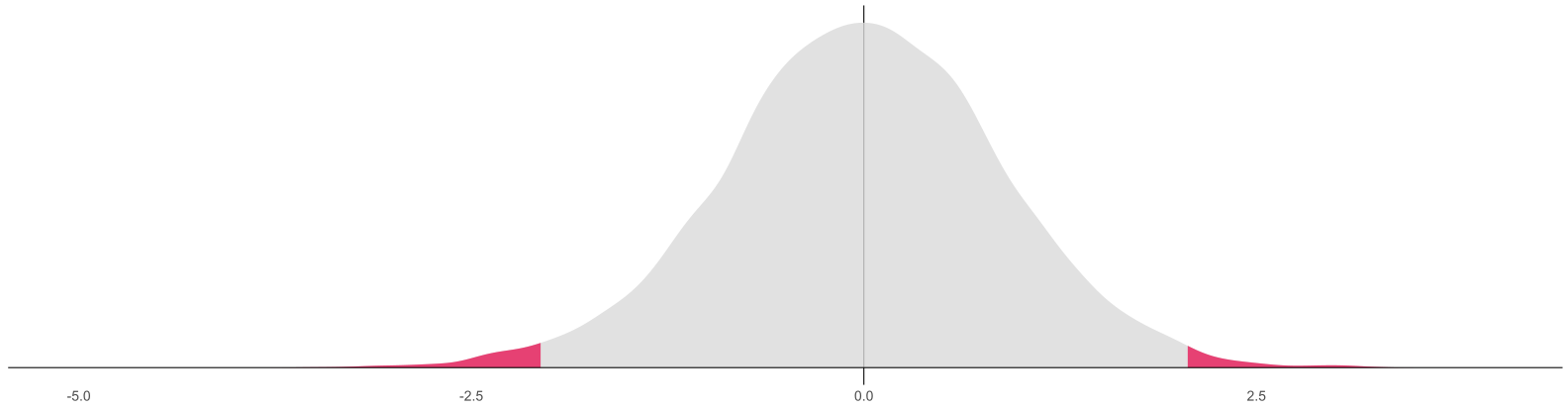
For each of the 10,000 samples, we will calculate the \(t\) statistic, and then we can see how many \(t\) statistics exceed our critical value (2.05, as above).
The answer should be approximately 5 percent—our \(\alpha\) level.
Hypothesis testing
In our simulation, 2.1 percent of our \(t\) statistics reject the null hypothesis.
The distribution of our \(t\) statistics (shading the rejection regions).
Hypothesis testing
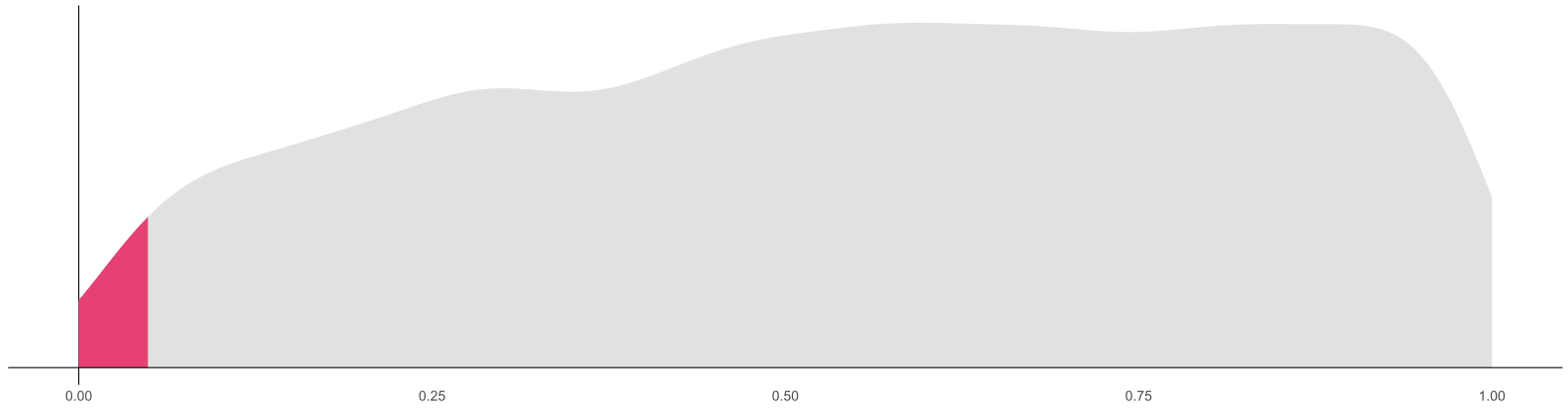
Correspondingly, 2.1 percent of our p-values reject the null hypothesis.
The distribution of our p-values (shading the p-values below 0.05).
F tests
You will sometimes see \(F\) tests.
We use \(F\) tests to test hypotheses that involve multiple parameters (e.g., \(\beta_1 = \beta_2\) or \(\beta_3 + \beta_4 = 1\)),
rather than a single simple hypothesis (e.g., \(\beta_1 = 0\), for which we would just use a \(t\) test).
F tests
Example
Economists love to say “Money is fungible.”
Imagine that we might want to test whether money received as income actually has the same effect on consumption as money received from tax rebates/returns.