Variance reduction methods

Applied Statistics

Ihor Miroshnychenko

Kyiv School of Economics

Stratification

Task

Suppose we have an online grocery store with delivery and want to increase the average revenue per user. To do this, we sent letters advertising the service to active customers.

Scenario:

  • Define the target metric.
  • Formulate a statistical hypothesis and criteria for testing it.
  • Record the minimum expected effect and acceptable probabilities of Type I and Type II errors.
  • Estimate the required group size.
  • Form an experimental and a control group.
  • Experiment.
  • Evaluate the results of the experiment.

Pipelines

  1. Target metric: Average revenue per user (ARPU).
  2. Statistical hypothesis: The average revenue per user in the experimental group is greater than in the control group.
    • Null hypothesis (\(H_0\)): \(\mu_{\text{exp}} \leq \mu_{\text{control}}\)
    • Alternative hypothesis (\(H_1\)): \(\mu_{\text{exp}} \neq \mu_{\text{control}}\)
  3. Minimum expected effect:
    • on historical data, the average revenue per user is \(250\) UAH with a standard deviation of \(80\) UAH. We expect an increase of at least \(10\) UAH.
    • Type I error probability: We set the significance level \(\alpha = 0.05\).
    • Type II error probability: We set the power of the test \(1 - \beta = 0.8\).
  4. Required group size:

\[ n = \frac{(Z_{1 - \alpha/2} + Z_{1 - \beta})^2 \cdot (\sigma_{\text{control}}^2 + \sigma_{\text{exp}}^2)}{\Delta^2} \]

where: - \(Z_{1 - \alpha/2}\) is the critical value for the significance level \(\alpha\), - \(Z_{1 - \beta}\) is the critical value for the power of the test \(\beta\). - \(\sigma_{\text{control}}\) and \(\sigma_{\text{exp}}\) are the standard deviations of the control and experimental groups, respectively, - \(\Delta\) is the minimum expected effect.

Group size

alpha  <- 0.05
beta  <- 0.2
mu_control <- 250
effect <- 10
mu_exp <- mu_control + effect
std  <- 80

z_alpha <- qnorm(1 - alpha / 2)
z_beta <- qnorm(1 - beta)
var  <-  2 * std^2 # assuming equal variance
sample_size  <- ceiling((z_alpha + z_beta)^2 * var / effect^2)
cat("Required group size:", sample_size, "\n")
Required group size: 1005 

FPR and Power

Let’s check the FPR and Power of the test with Monte Carlo simulation:

Code
set.seed(123)

results <- map_dfr(1:1000, ~ {
    control_one <- rnorm(sample_size, mu_control, std)
    control_two <- rnorm(sample_size, mu_control, std)
    exp <- rnorm(sample_size, mu_exp, std)

    FPR <- t.test(control_one, control_two, var.equal = TRUE)$p.value < alpha
    power <- t.test(control_one, exp, var.equal = TRUE)$p.value < alpha

    tibble(FPR = FPR, Power = power)
})

FPR_mean <- mean(results$FPR)
FPR_ci <- binom.test(sum(results$FPR), nrow(results), p = alpha, conf.level = 0.95)$conf.int
Power_mean <- mean(results$Power)
Power_ci <- binom.test(sum(results$Power), nrow(results), p = 1 - beta, conf.level = 0.95)$conf.int
cat("FPR:", FPR_mean, "\n", 
    "FPR CI:", FPR_ci, "\n",
    "Power:", Power_mean, "\n", 
    "Power CI:", Power_ci, "\n")
FPR: 0.059 
 FPR CI: 0.04521335 0.07544907 
 Power: 0.806 
 Power CI: 0.7801051 0.8300789 
  1. In practice, the exact values of distribution parameters are unknown, so estimates are used instead.
  2. It is recommended to take group sizes somewhat larger than the calculated.

Form experimental and control groups

Let’s assume we have a total of \(10000\) users, and we will randomly assign \(1005\) users to the experimental group and \(1005\) users to the control group.

set.seed(123)
n_total <- 10000
control_user_ids <- sample(1:n_total, sample_size)
exp_user_ids <- setdiff(1:n_total, control_user_ids) %>% 
    sample(sample_size)

user_groups <- bind_rows(
    tibble(user_id = control_user_ids, group = "control"),
    tibble(user_id = exp_user_ids, group = "exp")
)

Experiment

Let’s assume we have the following revenue data for the users in the experimental and control groups:

set.seed(123)
revenue_data <- tibble(
    user_id = 1:n_total,
    revenue = ifelse(user_id %in% control_user_ids, 
                     rnorm(sample_size, mu_control, std), 
                     rnorm(sample_size, mu_exp, std))
)
revenue_data %>% slice_sample(n = 5)
# A tibble: 5 × 2
  user_id revenue
    <int>   <dbl>
1    1088    333.
2     162    288.
3    1564    303.
4    6893    215.
5    9209    509.

Evaluate results

revenue_data_exp <- revenue_data %>%
    left_join(user_groups, by = "user_id") %>%
    drop_na() %>% 
    mutate(group = factor(group, levels = c("exp", "control")))

results <- revenue_data_exp %>%
    group_by(group) %>%
    summarise(mean_revenue = mean(revenue), 
              sd_revenue = sd(revenue), 
              n = n())
t_test_result <- t.test(revenue ~ group, data = revenue_data_exp, var.equal = TRUE)
cat("T-test p-value:", t_test_result$p.value, "\n",
    "CI:", t_test_result$conf.int, "\n")
T-test p-value: 1.697374e-05 
 CI: 8.433756 22.50601 

Stratification

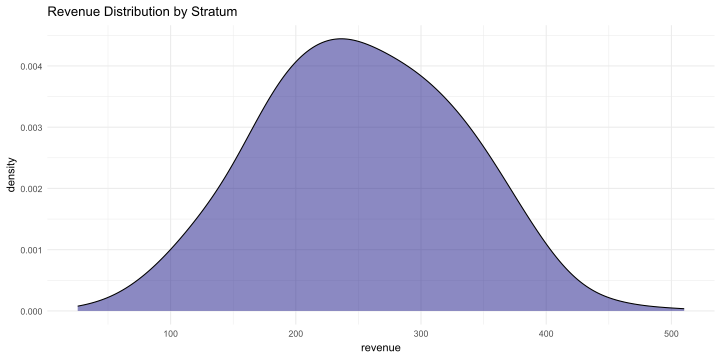
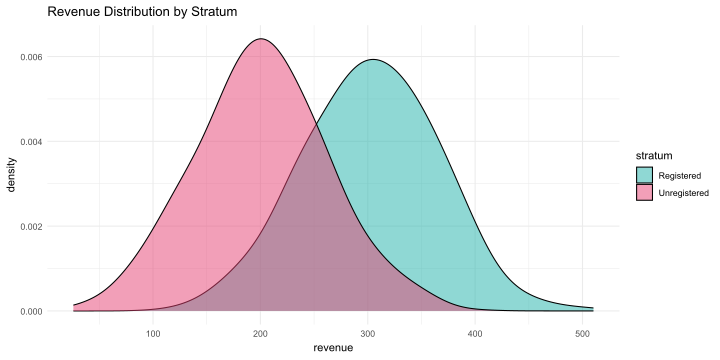
We have a loyalty program, but not all store users are registered. The behavior of registered users may differ from that of unregistered users. Information about registration in the loyalty program can increase the experiment’s sensitivity.

Covariates can be used to reduce variance and increase the sensitivity of the experiment by stratifying the sample.

Let’s:

  • The shares of strata in the population are equal and amount to 50%.
  • The average weekly revenue in the first stratum is 200 UAH, in the second stratum is 300 UAH.
  • The standard deviation in the first and second stratum is 62 UAH.

Strata’s visualization

set.seed(123)
strata_data <- tibble(
    stratum = rep(c("Unregistered", "Registered"), each = 1000),
    revenue = c(rnorm(1000, 200, 62), rnorm(1000, 300, 62))
)
ggplot(strata_data, aes(x = revenue, fill = stratum)) +
    geom_density(position = "identity", alpha = 0.5, adjust = 1.5) +
    labs(title = "Revenue Distribution by Stratum") +
    theme_minimal() +
    scale_fill_manual(values = c("Unregistered" = red_pink, "Registered" = turquoise))
ggplot(strata_data, aes(x = revenue)) +
    geom_density(position = "identity", alpha = 0.5, adjust = 1.5, fill=blue) +
    labs(title = "Revenue Distribution by Stratum") +
    theme_minimal()

When users are randomly distributed across groups, the strata sizes may be unequal.

AA test with stratification

Let’s conduct an AA test with stratification to check FPR.

Code
set.seed(123)

get_stratified_data <- function(stratum, n) {
    tibble(
        user_id = sample(1:10000, n),
        revenue = rnorm(n, mean = ifelse(stratum == "Registered", 300, 200), sd = 62),
        stratum = stratum
    )
}
stratum_sizes <- c(Registered = 5000, Unregistered = 5000)

result <- map_lgl(1:1000, ~ {
    stratified_data <- bind_rows(
        get_stratified_data("Registered", stratum_sizes["Registered"]),
        get_stratified_data("Unregistered", stratum_sizes["Unregistered"])
    )
    
    control_user_stratified <- stratified_data %>%
        group_by(stratum) %>%
        slice_sample(n = ceiling(sample_size / 2)) %>%
        ungroup()
    
    exp_user_stratified <- stratified_data %>%
        filter(!user_id %in% control_user_stratified$user_id) %>%
        group_by(stratum) %>%
        slice_sample(n = ceiling(sample_size / 2)) %>%
        ungroup()
    
    user_groups_stratified <- bind_rows(
        control_user_stratified %>% mutate(group = "control"),
        exp_user_stratified %>% mutate(group = "exp")
    )
    
    t.test(revenue ~ group, data = user_groups_stratified, var.equal = TRUE)$p.value < 0.05
})

cat("FPR:", mean(result), "\n",
    "FPR CI:", binom.test(sum(result), length(result), p = 0.05, conf.level = 0.95)$conf.int, "\n")
FPR: 0.005 
 FPR CI: 0.00162542 0.01162947 

Power with stratification

Let’s conduct a power analysis with stratification to check the power of the test.

Code
set.seed(123)

get_stratified_data_power <- function(stratum, n, effect = 10) {
    tibble(
        user_id = sample(1:10000, n),
        revenue = rnorm(n, mean = ifelse(stratum == "Registered", 300, 200) + effect, sd = 62),
        stratum = stratum
    )
}
stratum_sizes_power <- c(Registered = 5000, Unregistered = 5000)
result_power <- map_lgl(1:1000, ~ {
    stratified_data_power <- bind_rows(
        get_stratified_data_power("Registered", stratum_sizes_power["Registered"]),
        get_stratified_data_power("Unregistered", stratum_sizes_power["Unregistered"])
    )
    
    control_user_stratified <- stratified_data_power %>%
        group_by(stratum) %>%
        slice_sample(n = ceiling(sample_size / 2)) %>%
        ungroup()
    
    exp_user_stratified <- stratified_data_power %>%
        filter(!user_id %in% control_user_stratified$user_id) %>%
        mutate(revenue = revenue + effect) %>% 
        group_by(stratum) %>%
        slice_sample(n = ceiling(sample_size / 2)) %>%
        ungroup()
    
    user_groups_stratified <- bind_rows(
        control_user_stratified %>% mutate(group = "control"),
        exp_user_stratified %>% mutate(group = "exp")
    )
    
    t.test(revenue ~ group, data = user_groups_stratified, var.equal = TRUE)$p.value < 0.05
})
cat("Power:", mean(result_power), "\n",
    "Power CI:", binom.test(sum(result_power), length(result_power), p = 0.8, conf.level = 0.95)$conf.int, "\n")
Power: 0.865 
 Power CI: 0.8422441 0.8855809 

Stratified sampling made it possible to reduce the probabilities of Type I and Type II errors.

But we didn’t get quite the test we wanted initially.

Stratified mean

When calculating the stratified average, we calculate the simple average for each stratum separately. Then, we calculate their weighted sum, where the stratum’s weight is the stratum’s share in the population.

\[ \hat{X}_{str} = \sum_{i=1}^{k} w_i \bar{X}_i \]

where:

  • \(k\) is the number of strata,
  • \(w_i\) is the weight of the \(i\)-th stratum,
  • \(\bar{X}_i\) is the average of the \(i\)-th stratum.

Stratified variance

The stratified variance is calculated as follows:

\[ Var_{str} = \frac{1}{N} \sum_{i=1}^{k} w_i \sigma_i^2 \]

where:

  • \(N\) is the total sample size,
  • \(\sigma_i^2\) is the variance of the \(i\)-th stratum.

t-test with stratification

\[ t = \frac{\hat{X}_{strat, B} - \hat{X}_{strat, A}}{\sqrt{\sigma_{strat, B}^2 + \sigma_{strat, A}^2}} \sim t_{\gamma} \]

where:

  • \(\hat{X}_{strat, B}\) and \(\hat{X}_{strat, A}\) are the stratified averages of the experimental and control groups, respectively,
  • \(\sigma_{strat, B}^2\) and \(\sigma_{strat, A}^2\) are the stratified variances of the experimental and control groups, respectively.

AA and AB tests with stratification

Let’s conduct AA and AB tests with stratification to check FPR and Power.

Code
set.seed(321)

get_stratified_data_aa_ab <- function(stratum, n) {
    tibble(
        user_id = sample(1:10000, n),
        revenue = rnorm(n, mean = ifelse(stratum == "Registered", 300, 200), sd = 62),
        stratum = stratum
    )
}

stratum_sizes_aa_ab <- c(Registered = 5000, Unregistered = 5000)
result_aa <- map_lgl(1:1000, ~ {
    stratified_data_aa <- bind_rows(
        get_stratified_data_aa_ab("Registered", stratum_sizes_aa_ab["Registered"]),
        get_stratified_data_aa_ab("Unregistered", stratum_sizes_aa_ab["Unregistered"])
    )
    
    control_user_stratified <- stratified_data_aa %>%
        group_by(stratum) %>%
        slice_sample(n = ceiling(sample_size / 2)) %>%
        ungroup()
    
    exp_user_stratified <- stratified_data_aa %>%
        filter(!user_id %in% control_user_stratified$user_id) %>%
        group_by(stratum) %>%
        slice_sample(n = ceiling(sample_size / 2)) %>%
        ungroup()
    
    user_groups_stratified <- bind_rows(
        control_user_stratified %>% mutate(group = "control"),
        exp_user_stratified %>% mutate(group = "exp")
    )
    
    strat_a_mean <- user_groups_stratified %>%
        filter(group == "control") %>%
        group_by(stratum) %>%
        summarise(mean_revenue = mean(revenue), .groups = "drop") %>% 
        summarise(mean_revenue = mean(mean_revenue))
    strat_b_mean <- user_groups_stratified %>%
        filter(group == "exp") %>%
        group_by(stratum) %>%
        summarise(mean_revenue = mean(revenue), .groups = "drop") %>%
        summarise(mean_revenue = mean(mean_revenue))
    strat_a_var <- user_groups_stratified %>%
        filter(group == "control") %>%
        group_by(stratum) %>%
        summarise(var_revenue = var(revenue), .groups = "drop") %>%
        summarise(var_revenue = mean(var_revenue))
    strat_b_var <- user_groups_stratified %>%
        filter(group == "exp") %>%
        group_by(stratum) %>%
        summarise(var_revenue = var(revenue), .groups = "drop") %>%
        summarise(var_revenue = mean(var_revenue))
    delta_mean <- strat_b_mean$mean_revenue - strat_a_mean$mean_revenue
    std <- sqrt(strat_a_var$var_revenue / nrow(control_user_stratified) + strat_b_var$var_revenue / nrow(exp_user_stratified))
    t = delta_mean / std
    pvalue <- 2 * pt(abs(t), df = nrow(user_groups_stratified) - 2, lower.tail = FALSE)
    pvalue < 0.05
})


cat("FPR AA:", mean(result_aa), "\n",
    "FPR CI AA:", binom.test(sum(result_aa), length(result_aa), p = 0.05, conf.level = 0.95)$conf.int, "\n")
FPR AA: 0.04 
 FPR CI AA: 0.02872763 0.0540727 

AB test with effect

Code
set.seed(123)

result_ab <- map_lgl(1:1000, ~ {
    stratified_data_ab <- bind_rows(
        get_stratified_data_aa_ab("Registered", stratum_sizes_aa_ab["Registered"]),
        get_stratified_data_aa_ab("Unregistered", stratum_sizes_aa_ab["Unregistered"])
    )
    
    control_user_stratified <- stratified_data_ab %>%
        group_by(stratum) %>%
        slice_sample(n = ceiling(sample_size / 2)) %>%
        ungroup()
    
    exp_user_stratified <- stratified_data_ab %>%
        filter(!user_id %in% control_user_stratified$user_id) %>%
        mutate(revenue = revenue + 10) %>%  # Adding effect
        group_by(stratum) %>%
        slice_sample(n = ceiling(sample_size / 2)) %>%
        ungroup()
    
    user_groups_stratified <- bind_rows(
        control_user_stratified %>% mutate(group = "control"),
        exp_user_stratified %>% mutate(group = "exp")
    )
    
    strat_a_mean <- user_groups_stratified %>%
        filter(group == "control") %>%
        group_by(stratum) %>%
        summarise(mean_revenue = mean(revenue), .groups = "drop") %>% 
        summarise(mean_revenue = mean(mean_revenue))
    strat_b_mean <- user_groups_stratified %>%
        filter(group == "exp") %>%
        group_by(stratum) %>%
        summarise(mean_revenue = mean(revenue), .groups = "drop") %>%
        summarise(mean_revenue = mean(mean_revenue))
    strat_a_var <- user_groups_stratified %>%
        filter(group == "control") %>%
        group_by(stratum) %>%
        summarise(var_revenue = var(revenue), .groups = "drop") %>%
        summarise(var_revenue = mean(var_revenue))
    strat_b_var <- user_groups_stratified %>%
        filter(group == "exp") %>%
        group_by(stratum) %>%
        summarise(var_revenue = var(revenue), .groups = "drop") %>%
        summarise(var_revenue = mean(var_revenue))
    delta_mean <- strat_b_mean$mean_revenue - strat_a_mean$mean_revenue
    std <- sqrt(strat_a_var$var_revenue / nrow(control_user_stratified) + strat_b_var$var_revenue / nrow(exp_user_stratified))
    t = delta_mean / std
    pvalue <- 2 * pt(abs(t), df = nrow(user_groups_stratified) - 2, lower.tail = FALSE)
    pvalue < 0.05
})
cat("Power AB:", mean(result_ab), "\n",
    "Power CI AB:", binom.test(sum(result_ab), length(result_ab), p = 0.8, conf.level = 0.95)$conf.int, "\n")
Power AB: 0.96 
 Power CI AB: 0.9459273 0.9712724 

CUPED

Basic idea

Looking in the past

CUPED formula

CUPED (Controlled-experiment Using Pre-Experiment External Data) — a method for reducing dispersion in A/B tests by adjusting the target metric Y using covariate X (pre-experiment data).

\[ Y_{cuped} = Y - \theta \cdot (X) \]

where:

  • \(Y_{cuped}\) is the adjusted target metric,
  • \(Y\) is the original target metric,
  • \(\theta\) is the coefficient that minimizes the variance of \(Y_{cuped}\),
  • \(X\) is the covariate (pre-experiment data).

Estimating theta

Goal: minimize the variance of \(Y_{cuped}\).

Steps:

  1. Variance of \(Y_{cuped}\):

\[ Var(Y_{cuped}) = Var(Y) - 2\theta Cov(X, Y) + \theta^2 Var(X) \]

  1. Differentiate with respect to \(\theta\) and set to zero:

\[ \frac{d}{d\theta} Var(Y_{cuped}) = 2\theta Var(X) -2 Cov(X, Y) = 0 \]

  1. Solve for \(\theta\):

\[ \theta = \frac{Cov(X, Y)}{Var(X)} \]

Final formula for variance of \(Y_{cuped}\):

\[ Var(Y_{cuped}) = Var(Y)(1 - r^2) \]

where \(r\) is the correlation coefficient between \(X\) and \(Y\).

Examples of covariates

Any metric that correlates with the target metric that will not be affected by the treatment.

  1. The same metrics as before the test
    • For Retention: Retention for the previous month
    • For CTR: CTR for the last week
  2. Synthetic predictors
    • ML prediction of metrics based on historical data
  3. Ideas for other metrics
    • Average session time for the last 7 days
    • Frequency of feature usage before the experiment
  4. Demographics/Technical parameters
    • Age, country, device type (if stable)

Cases

  1. Netflix (from the paper by Huizhi Xie, Juliette Aurisset, 2016):
    • For streaming hours among existing users:
      • CUPED reduced dispersion by 40%
      • Covariate: streaming hours per month before the experiment
  2. Microsoft (Laura Cosgrove, Jen Townsend, and Jonathan Litz, 2022):
    • CTR:
      • CUPED was akin to adding 20% more traffic to analysis of a majority of metrics
      • Covariate: CTR over the last 2 weeks

Main points

  1. Correlation is key
    • Minimum requirement \(|r| > 0.3\).
  2. Covariate stability
    • The covariate should not depend on the experimental intervention.
  3. For new users
    • The effect is weaker due to a lack of historical data (in Netflix: 5-15% reduction in variance)
  4. Good old OLS
    • CUPED is equivalent to OLS regression with fixed \(\theta\).

CUPED in R

Functions for generating data, calculating \(\theta\), and performing CUPED:

Code
library(mvtnorm) # for rmvnorm

generate_data <- function(sample_size, corr, mean = 2000, sigma = 300) {
  means <- c(mean, mean) # mean for both metrics
  cov_matrix <- sigma^2 * matrix(c(1, corr, corr, 1), nrow = 2) # covariance matrix
  data <- rmvnorm(sample_size, mean = means, sigma = cov_matrix) %>% round() # generate correlated data
  
  tibble(
    metric = data[, 1], # target metric (e.g., revenue)
    covariate = data[, 2] # covariate (e.g., pre-experiment data)
  )
}

calculate_theta <- function(metrics, covariates) {
  cov_xy <- cov(covariates, metrics) # covariance between covariate and metric
  var_x <- var(covariates) # variance of covariate
  theta <- cov_xy / var_x # calculate theta
  return(theta)
}

check_ttest <- function(df_control, df_pilot) {
  t.test(df_control$metric, df_pilot$metric)$p.value
}

check_cuped <- function(df_control, df_pilot, df_theta) {
  theta <- calculate_theta(df_theta$metric, df_theta$covariate)
  cuped_control <- df_control$metric - theta * df_control$covariate
  cuped_pilot   <- df_pilot$metric   - theta * df_pilot$covariate
  t.test(cuped_control, cuped_pilot)$p.value
}

CUPED in R

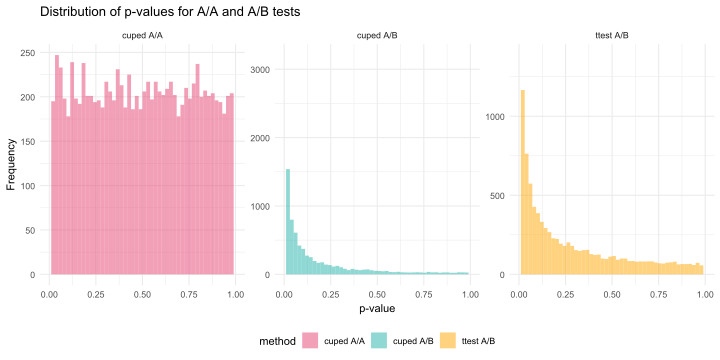
Test the CUPED method with Monte Carlo simulation:

Code
simulate_pvalues <- function(n_iter = 10000, sample_size = 1000, corr = 0.7, effect = 20) {
  map_dfr(seq_len(n_iter), function(i) {
    df_control <- generate_data(sample_size, corr)
    df_pilot <- generate_data(sample_size, corr)
    df_theta <- bind_rows(df_control, df_pilot)

    # A/A: без ефекту
    p_aa <- check_cuped(df_control, df_pilot, df_theta)

    # A/B: з ефектом
    df_pilot_ab <- df_pilot %>% mutate(metric = metric + effect)
    df_theta_ab <- bind_rows(df_control, df_pilot_ab)

    p_ab_cuped <- check_cuped(df_control, df_pilot_ab, df_theta_ab)
    p_ab_ttest <- check_ttest(df_control, df_pilot_ab)

    tibble(
      method   = c("cuped A/A", "cuped A/B", "ttest A/B"),
      p_value  = c(p_aa, p_ab_cuped, p_ab_ttest)
    )
  })
}

set.seed(42)

# Генерація та графік
df_pvalues <- simulate_pvalues(n_iter = 10000, sample_size = 1000, corr = 0.7, effect = 20)

df_pvalues %>%
  ggplot(aes(x = p_value, fill = method)) +
  geom_histogram(position = "identity", alpha = 0.5, bins = 50) +
  labs(title = "Distribution of p-values for A/A and A/B tests",
       x = "p-value",
       y = "Frequency") +
  scale_fill_manual(values = c("cuped A/A" = red_pink, 
                                "cuped A/B" = turquoise, 
                                "ttest A/B" = orange)) +
  theme_minimal() +
  theme(legend.position = "bottom") +
  facet_wrap(~ method, scales = "free_y") +
  xlim(0, 1)
Code
df_pvalues %>%
  group_by(method) %>%
  summarise(
    FPR = mean(p_value < 0.05 & method == "cuped A/A"),
    Power = mean(p_value < 0.05 & method %in% c("cuped A/B", "ttest A/B"))
  )
# A tibble: 3 × 3
  method       FPR Power
  <chr>      <dbl> <dbl>
1 cuped A/A 0.0508 0    
2 cuped A/B 0      0.551
3 ttest A/B 0      0.329